This post might be created with help from AI tools and carefully reviewed by a human (Anthor Kumar Das). For more on how we use AI on this site, check out our Editorial Policy. This post contains affiliate links. We may earn a small commission at no extra cost to you. Learn more.
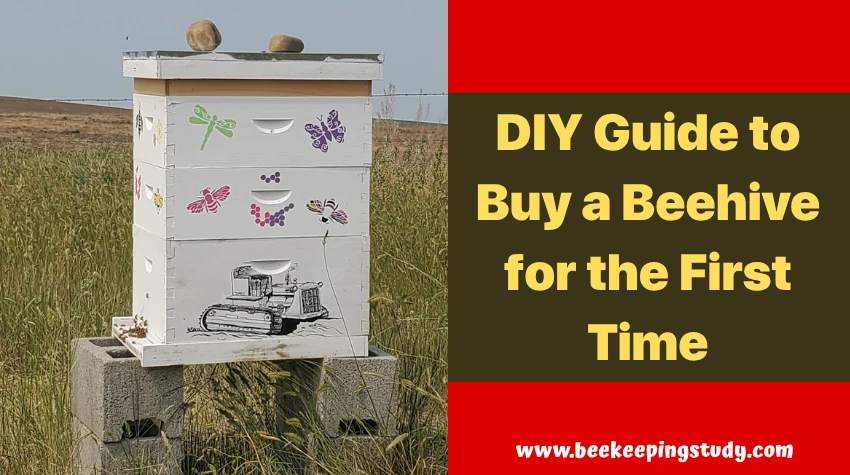
DIY Guide on How to Buy Your First Beehive
When it comes to the question of what is the best type of beehive for beginners, there is no single answer. When someone says the Langstroth beehive is ideal for beginners, others will say a top-bar or Warré is the ideal option for you.
Because the ideal type for one may vary from another. It totally depends on your environmental conditions, your aim, and how you are willing to get involved in the beekeeping occupation.
I have been connected with beekeeping since 2014. I have discussed with a lot of beekeepers in the USA, the UK, and in many other regions as well. I tried to learn a lot of things related to beekeeping, including what other expert beekeepers are talking about regarding the best type of beehive for beginners.
That’s what I am going to cover with you in this article. You will get a complete DIY guide with a checklist to buy your first beehive. How to choose the ideal beehive for you and how to start the preparation before you kick off your first apiary.
Different Types of Beehives (Options Available Worldwide for Beekeepers)
There are mainly 3 types of beehives in the United States. However, worldwide, there are 6 most common types of beehives available.
- Langstroth.
- Top Bar.
- Warre.
- British National Hive.
- Flowhive.
- Apimaye.
Let’s explore each type with its advantages and disadvantages.
Langstroth Hive (The Industry Standard)
In the United States, you will commonly see the Langstroth hive is the most popular one among beekeepers. Due to its industry-standard setup, ease of maintenance, and heavy honey harvestment makes it popular.
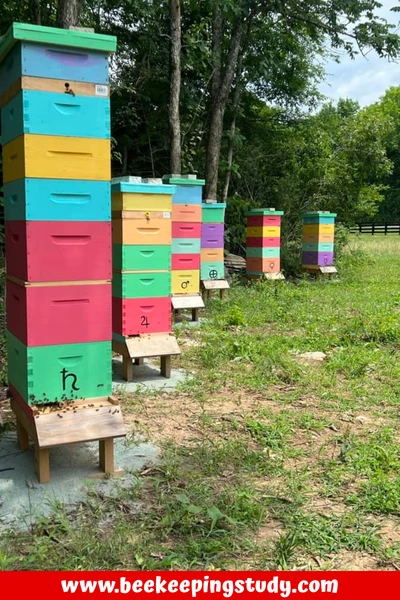
It is popular among beginners in the United States due to its modular design, removable frames, straightforward and easy inspections, feeding, mite checks, and, most importantly, broader local support.
Major Advantages of Langstroth Hive
- Ideal if your main aim is getting high yields of honey per beehive every year. This also wins when main is to get maximum bee pollen, beeswax, and royal jelly.
- Most of the local and online beekeeping-related tutorials and resources are based on the Langstroth hive.
- Removable frames and supers.
- Easy to switch between a double-brood-box system and a single-brood-box system.
- Equipment such as frames, boxes, and tools is widely available and interchangeable.
- Most of the nucleus of bees, or package bees, are designed to be set up on a Langstroth beehive.
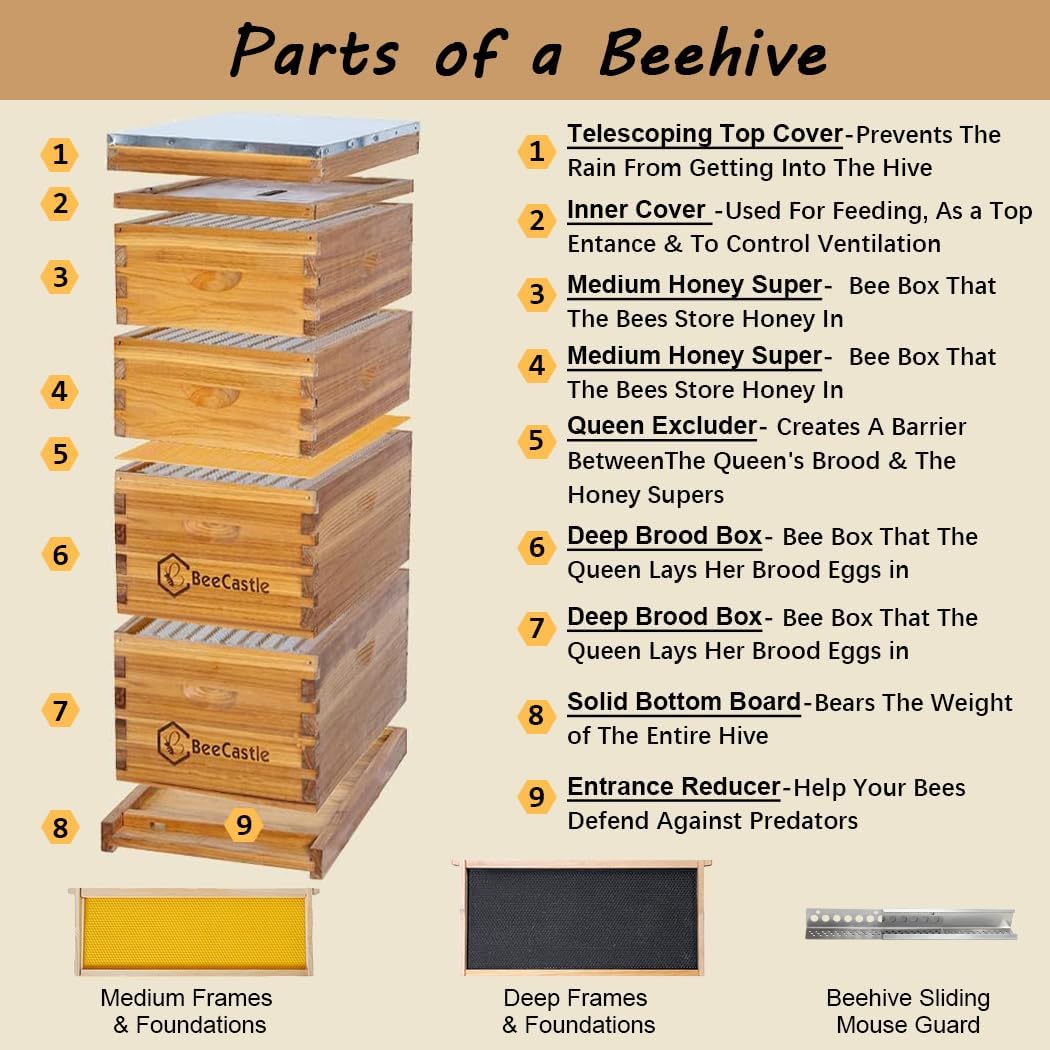
BeeCastle 10-Frame Langstroth Bee Hive – 2 Deep & 2 Medium Boxes, 100% Beeswax Coated
Complete 4-box Langstroth setup with frames and waxed foundations included – 2 deep brood boxes for colony growth and 2 medium supers for honey harvesting. Ready for your first nuc or package transfer.
See Price on Amazon →
Disadvantages of Langstroth Hive
- Require regular maintenance.
- Need hands-on experience before getting started.
- Require heavy lifting. Each honey super can weigh between 60 and 90 lbs.
British National Hive (The UK Standard)
This special type of beehive is mostly popular in the United Kingdom and Ireland. British National hive is specially designed for UK beekeepers, and 80% of beekeepers in united kingdom uses this type of beehive.
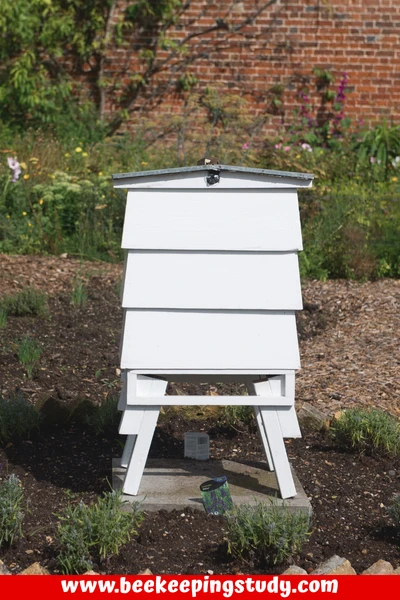
It is specially designed to suit the United Kingdom climate. A standard National Hive consists of a brood box and multiple supers, each holding 10–12 frames, and can accommodate a colony of 50,000 to 60,000 bees.
Advantages of British National Hive
- British Standard frames (14″ x 8.5″ brood) are lighter than Langstroth frames.
- Modular design that allows adaptation and expansion with colony growth.
- High resource availability and local community support throughout the UK.
- Widest parts and equipment availability across the UK and Ireland.

British Standard National Beehive, Anatolian Cedar Wood, Complete Set with Queen Excluder
Complete British National Hive set made in Europe from Anatolian cedar wood. Includes wire queen excluder and landing board, ready for your first colony in the UK climate.
See Price on Amazon →
Disadvantages of BN Hive
- Not compatible with Langstroth frames.
- Less honey production due to less space for bees in small brood boxes.
- Not widely available outside UK.
Top Bar (Underestimated but Great for Learning)
The top bar beehive is another great type of beehive for those who want to learn more about honey bees. This one is also cost-saving as well.
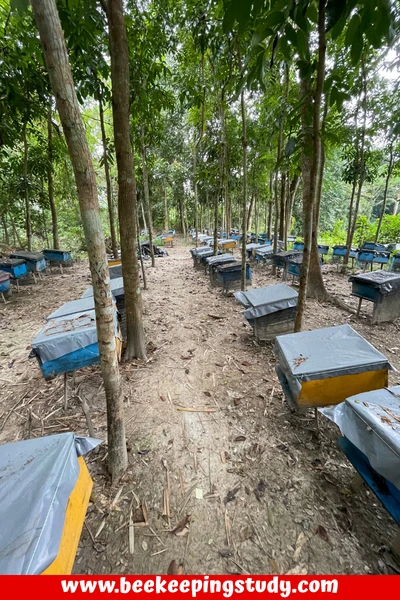
If you want to see and learn how honey bees build comb from scratch, and don’t have much time for maintanence than you can go with this one. However, it is only suitable for warmer regions and not recommended for cold regions.
Advantages of Top Bar Beehives
- Great for learning who wants to see and seeing comb building from scratch.
- Horizontal design, thus no heavy lifting required.
- Less inspection and maintanence require as above from ground and no separate super available.
- Bees build natural comb without foundation, which keeps the cell size ideal.
- Can be a cost saver as easy to build as a DIY project.
- Package bees or a swarm of bees can be easily transferred.
Disadvantages of Top Bar Beehives
- Needs hands-on experience as learning resources are limited.
- Disease detection, honey harvestment, overpopulation can be serious challenges if not have expertise.
- High chance of breaking comb during inspection and difficult winter feeding.
- Lower yields of honey per year.
- Nucs can not be transferred to a top bar hive.
Note: As I have a large apiary currently, I am using top bar beehives. This is to ensure I can manage my apiary properly without a huge number of workers.
Warré Hive(Lowest Maintenance Required)
Warré Hive is also known as “The People’s Hive” as it mimics natural spaces that bees use for their hives. This type of hive requires the lowest possible maintenance. Only seasonal inspection is required.
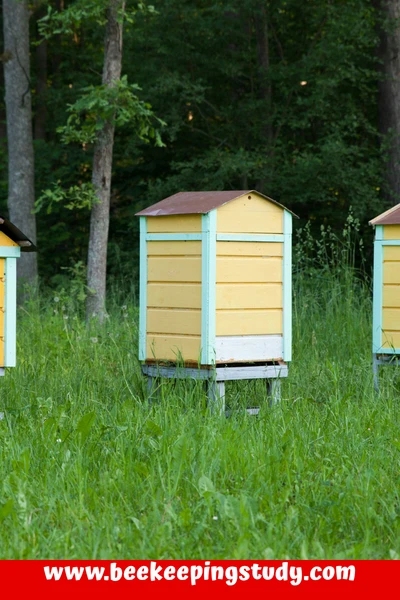
However, it also produces the lowest yields of honey. But it produces a high amount of beeswax. The bee products, such as honey, beeswax, and bee pollen, extracted from this hive are considered the most authentic.
Advantages of Warré Hive
- Designed for minimal intervention. The philosophy is “let the bees manage themselves”.
- Requires seasonal maintenance only.
- Highest amount of beeswax per year.
- Very lightweight.
Disadvantages of Warré Hive
- Equipment and parts are mostly not interchangeable.
- Difficult to add boxes at the top. To add a new box at the bottom, the entire hive has to be lifted temporarily.
- Lowest yields of honey per year.
- Limited resources and lowest community support.

Natural Beekeeping with the Warre Hive: A Manual
Covers everything from building and siting your Warre hive to obtaining bees, monitoring, feeding, wintering, and harvesting honey with simple kitchen equipment. An ideal guide for aspiring natural beekeepers.
Flow Hive (The High-Tech Option)
The flow hive is a modified version of a Langstroth beehive. As the name suggests, the frames are designed to release honey through a tap without opening the hive. The frames are mostly built with plastic materials.
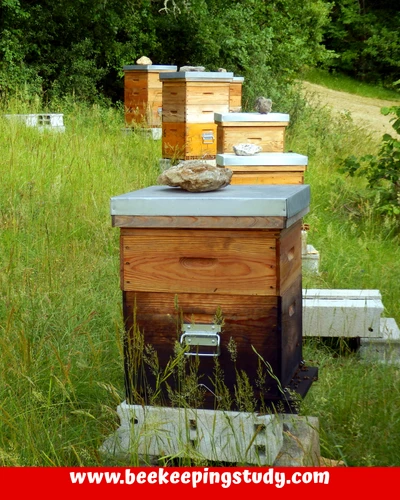
The Flow system makes honey harvesting easier and less stressful for both the beekeeper and the bees.
“Consider the scenario of sap dripping from a date palm tree – where a small wooden spout (or tap) is driven into the upper trunk, and the sap trickles down along it into a collection pot.” The same you can think of when using a flow hive.
Advantages of a Flow Hive
- Honey extraction doesn’t require any extractor or even opening the hive.
- Compatible with standard brood boxes and frames.
- Beautiful cedar construction with observation windows.
- Automatic honey extraction saves, time, labour and resources.

Automatic Flow Bee Hive Kit – 7 PCS Auto Frame Comb, Wooden Construction
Turn a tap and watch honey flow directly into your jar – 7 auto-drain frames eliminate the need for an extractor. Less stress on bees, less work for you. Compatible with standard brood boxes.
Disadvantages of a Flow Hive
- Very expensive ($1500-$3000+).
- An experienced beekeeper warned that Flow Hives may not be good for beginning beekeepers to start their journey with and be successful. The cedar wood can dry out in extreme climates, and the vaulted top invites bees to build comb in it.
- Require full colony management and inspection similar to a Langstroth hive. Only reduces honey harvest workload.
Apimaye Hive (The Insulated, Climate-Resistant Option)
Apimaye hive is specialized in keeping bees warm during winter. This provides better insulation than any other type of beehive. So, if you are living in a colder region, this can be a great option for you as well.
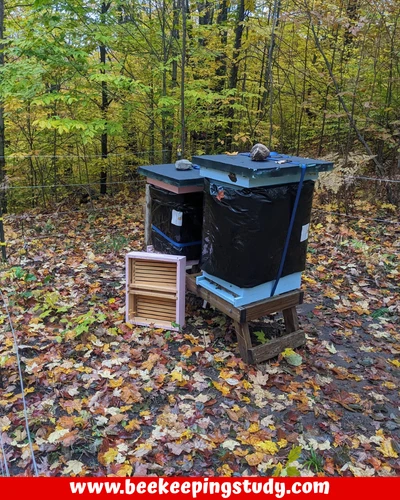
This also provides ventilation during winter. Thus suitable for both cold and warmer regions.
Advantages of Apimaye Hive
- Double-wall insulated plastic construction: superior temperature regulation in both extreme heat and cold.
- Built-in screened bottom board, ventilation system, and entrance reducer.
- Resistant to rot, moisture, and pest damage.
- Uses standard Langstroth frames, thus interchangeable.
- Low maintenance required.

Ergo Apimaye Insulated Bee Hive – Single Deep with PRO Frames & Wax Foundation
Double-wall insulated hive built for extreme heat and cold. Includes plastic PRO frames with premier wax foundations, ready for your first colony.
Disadvantages of Apimaye Hive
- Extremely expensive.
- Not reusable for long. Difficult to repair and modify.
- Heavier than wooden beehives.
- Plastic construction bothers beekeepers who prefer natural materials.
The Beehive Type that is Suitable for Others Might Not Suit You
This is the real truth about the best type of beehive for beekeeping. Because no one can give a single beehive type to be universally ideal worldwide.
You have to learn your goal, method of beekeeping, and local environmental conditions. Based on these, you can decide the ideal beehive type for you.
Such as, if your main aim is honey production, a Langstroth or Flow hive is ideal for you. On the other hand, if you want to keep bees as a hobby and learn from scratch, you can go with a top bar or warré hive.
Expert Tip: If you are from US go for Langstroth or Flow Hive. If you are from UK region go with BN Hive.
Here is an overall comparison of the available beehive types as discussed above.
Our Top Picks Based on Your Region
BeeCastle 10-Frame Langstroth Bee Hive, 2 Deep & 2 Medium Boxes
100% beeswax coated with frames and waxed foundations included
British Standard National Beehive, Anatolian Cedar Wood, Complete Set
Includes wire queen excluder and landing board, made in Europe
Checklist & Preparation to Buy Your First Beehive
If you have decided the type of beehive you are going to purchase, you are not done yet. Here comes the toughest but most important part. Because if you are not prepared enough, your money and effort will go to waste.
This is why it is recommended to follow this checklist and take necessary preparations before buying your first beehive.
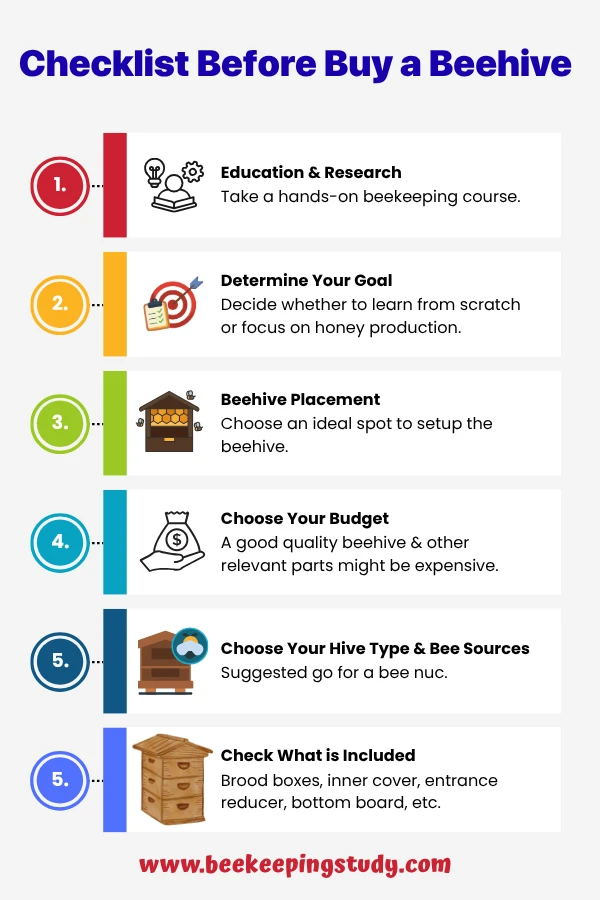
Phase 1: Education & Research (Do This First)
Your possibility of success in beekeeping will be increased if you are prepared enough. This is why learning beekeeping is most important.
- Take a hands-on beekeeping training course if possible.
- At least get a mentor who has been involved in beekeeping for years.
- Join the local beekeeping community.
- Check local beekeeping laws and regulations.
- Join beekeeping groups and follow beekeeping pages.
Best Beekeeping Books for Beginners — Compared


| Feature | Beekeeping for Beginners | The Backyard Beekeeper | The Beekeeper’s Bible |
|---|---|---|---|
| Best For | Total beginners | Backyard hobbyists | All-in-one reference |
| Covers Hive Building | ✔ | ✔ | ✘ |
| Honey Recipes | ✘ | ✘ | ✔ |
| Includes Bonus Material | ✔ | ✘ | ✘ |
| Colony Management | ✔ | ✔ | ✔ |
| Rating | 4.6+ ★ | 4.6+ ★ | 4.8+ ★ |
| Buy | See Price → | See Price → | See Price → |
Phase 2: Decide on your beekeeping goals
Are you keeping bees for honey production, pollination, conservation, education, or all of the above? Your goals directly influence which hive type, bee breed, and equipment you’ll need.
If you are thinking of starting beekeeping as full time work than you need a different approach. You have to learn the best practices for commercial beekeeping.
Though you can start with just 2 and then expand to the number of hives usually commercial beekeepers have. This can be from 10 to thousands. Make sure you have enough human and other resources for proper maintenance.
Phase 3: Beehive Location & Site Preparation
You can’t put your beehives in any random location. You have to place your apiary in a location where sunlight is available early in the day.
For beehive location and site preparation, you can ensure these.
- Choose a location for the beehive that receives good morning sunlight, shade in the late afternoon, protection from strong winds, good airflow, and access to a water source.
- Install a 6-foot fence, hedge, or similar barrier in front of the hive. This will force the bees’ flight path up and over people’s heads, effectively eliminating most accidental contact.
- Ensure the area is away from pesticide exposure.
- Ensure the hive location is away from public transportation.
- Make sure there are enough pollination-friendly plants available around.
Phase 4: Choose Your Budget
The overall beekeeping cost greatly varies based on the investment in the beehive and bees. Expect to spend $700–$1,500 for your first year, including bees, hive, gear, and feeding supplies. The second hive costs less because you already own the tools and protective gear.
Pro tip: You can use our beekeeping cost calculator to estimate your beekeeping expected cost. Also, you can use beekeeping profitability calculator to get an idea of how much you can earn from beekeeping.
Phase 5: Choose Your Hive Type & Bee Sources
From the above discussion, you can easily identify which type of beehive are suitable for you. Then you have to choose the ideal honey bee types that are suitable specifically for your region. Local beekeepers can give you the most accurate answer about that.
Expert Tip
If you are in the US, start with a Langstroth. If you are in the UK, the British National is the safest choice. Both offer the widest local support, mentor availability, and equipment compatibility for beginners.
Decide: 8-frame or 10-frame (Langstroth)
This creates the most common confusion among beekeepers. 10-frame is the industry standard with maximum honey production. 8-frame is lighter and easier on the back. Pick one and stick with it.
Nuc vs Package Bees
For beginners, my recommendation is to go for a Nuc of bees. Because a bee nuc is tested and the queen is actively laying. Thus, it is a safe option.
Most bee nucs are created to be easily transferred to a full-sized Langstroth or British National Hive.
Pro Tip: Nucs and packages sell out fast. Thus pre-order bees early December–January for spring delivery. Make sure to purchase bees from an authenticate source.
Phase 6: What is Included & What to Expect
Before you get your nuc, you must prepare your beehive. So, before getting your beehive, you must know what is included with it and what other things you must gather and assemble.
Beehive Components
When purchasing your first beehive, ensure you are getting a complete package with the mandatory equipment.
Either purchase them all together or purchase each individually.
- 2 deep brood boxes with 20 frames and foundation.
- Bottom board (screened with removable insert).
- Inner cover and telescoping outer cover.
- Entrance reducer.
- Hive stand or cinder blocks.
Other Things You Might Need to Buy Separately
These are not included in a beehive package, but you have to purchase them for ease of hive management.
- Protective gear: A full bee suit, or at least a bee veil with bee jacket and gloves.
- Essential tools: Smoker, Hive Tool, Bee Brush.
- Feeding supplies: Top feeder (preferred over entrance feeder).
Gear Up Before You Split

LONGADS Professional Bee Suit – Full Body with Gloves & Round Veil
Cover your entire body before approaching the hive – bees get defensive during a split

Bee Hive Smoker – Stainless Steel with Heat Shield
Push smoke upon the entrance before opening – keeps bees calm while you lift frames

Mudder Stainless Steel Hive Tool & Bee Brush Set – J Hook Lifter & Scraper
Lift frames one by one to inspect brood, honey, and queen cells during the split
So, Ready to Buy a Beehive for the First Time?
Hopefully now you have the complete checklist and DIY guide to plan your first beehive purchase. Are you ready to buy a beehive for the first time? What is your experience? Let me know. I will be happy to help you with any enquiries.