This post might be created with help from AI tools and carefully reviewed by a human (Anthor Kumar Das). For more on how we use AI on this site, check out our Editorial Policy. This post contains affiliate links. We may earn a small commission at no extra cost to you. Learn more.
How to Identify Queen Bee in a Beehive

When I started my beekeeping, I was struggling a bit identifying the queen during hive inspection. With time, I learned the rule of how to identify queen bee in a beehive easily. Here is a simple rule for you.
The queen is larger than all other bees in the apiary, has a clear and dark abdomen with less hair or is completely hairless.
Not just the appearance, the queen is different in behaviour and reacting to hive inspection as well. To make things easier for you, I will explain to you how to identify the queen bee in a beehive. I will also let you know my hive inspection technique to spot the queen easily.
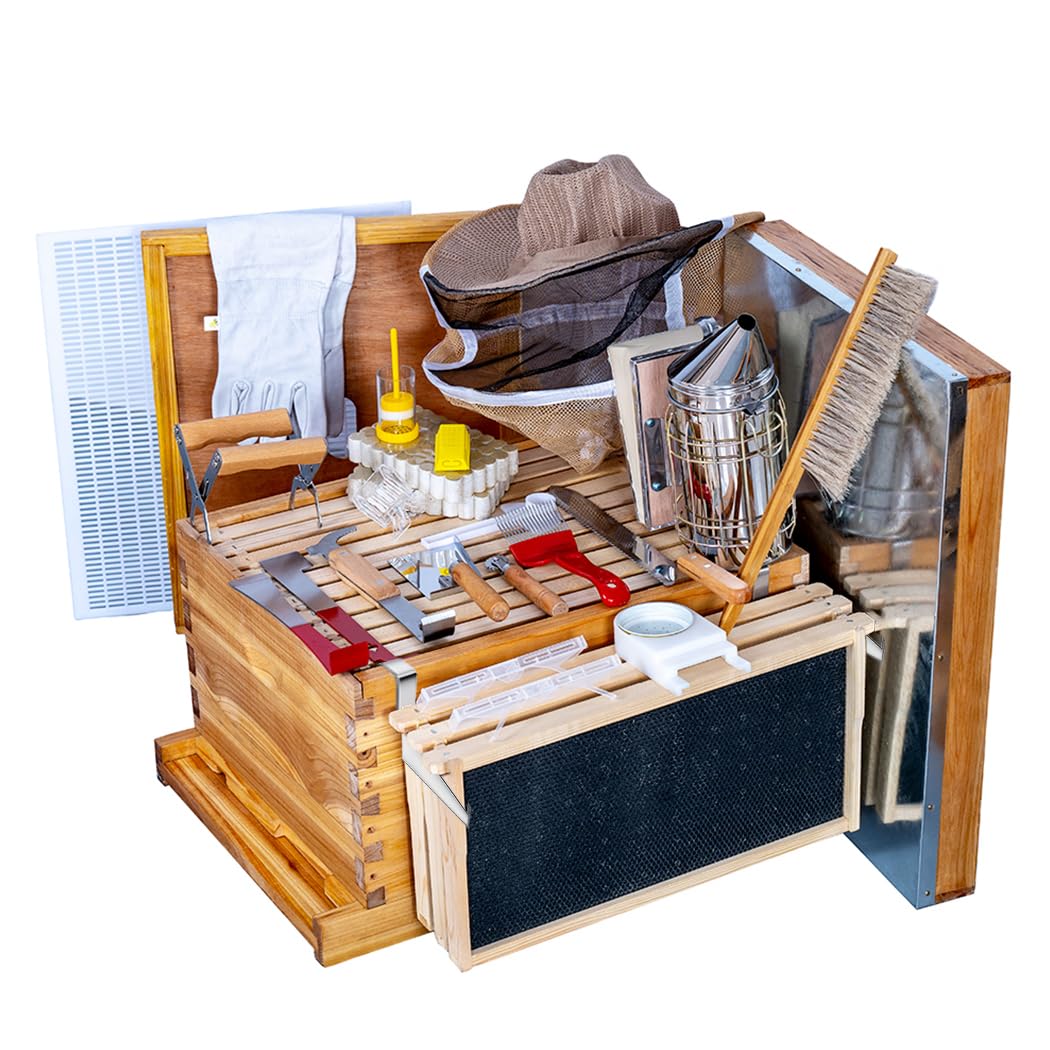
Beehive Starter Kit — 8-Frame Wax Coated Bee Boxes with Tools & Veil
Complete 8-frame setup with wax coated hive boxes, frames, beekeeping tools kit and veil — everything compatible right out of the box.
See Price on Amazon →
How to Tell Apart the Queen Bee from Other Bees in a Beehive
The queen bee has a lot of distinct features compared to other bees. In a honey bee colony, there are mainly 3 types of bees with distinct roles and appearances.
| Type of Bees | Appearances | Roles |
| Worker Bees | Sterile bee, smaller in size, with a thin, hairy body. | Caring broods and queen, foraging, and defense. |
| Drone Bees | Medium in size, less dense hairy body, very large eyes that almost touch on top of the head. | Mostly idle, and its only purpose is to mate with the queen bee. |
| Queen Bee | The largest fertile female with less hair or hairless body, clear shiny abdomen, splead legs. | Laying eggs and allocating roles for workers through pheromones. |
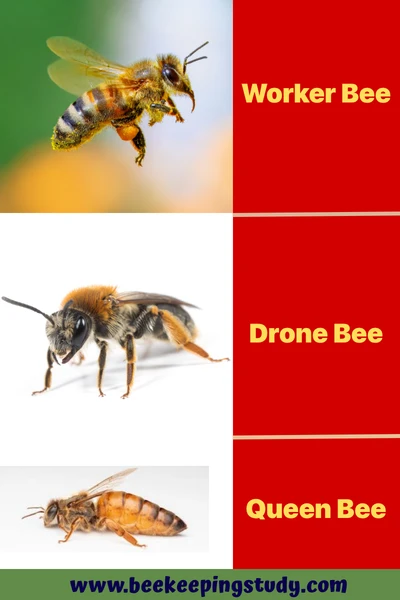
The queen bee is the center of the entire honey bee colony. The distribution of all the roles and work within the colony is done by the pheromone released from the queen’s body.
So, How Does The Queen Bee Look?
The queen bee has a different look than other bees. Here are the most common appearance characteristics of the queen bee in different types of honey bee colonies.
- The queen is the largest member of the colony.
- She has a clear, shiny, large, less hairy or hairless abdomen.
- Her wings are shorter than worker bees.
- The queen has splead legs on both sides of her body.
- The queen’s abdomen has a caramel color or, in some cases, a black or brown color.
- The queen’s abdomen is totally hairless. On the other hand, the worker bees abdomen is fuzzy and hairy.
- She has a clear and sharp sting which she can use repeatedly.
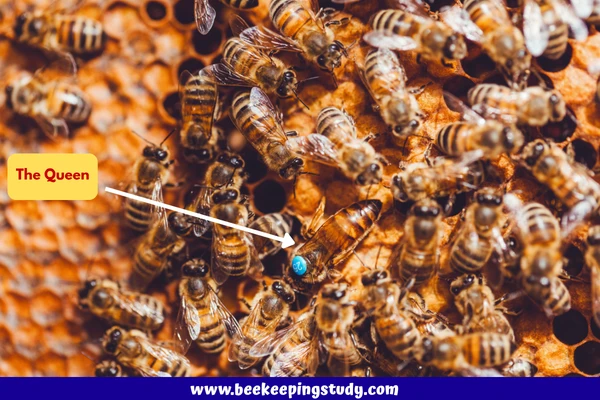
- The most common pattern is that you will see some attendance bees in a circle around the queen. Their face is pointing to the queen. If the queen moves, those attendance will move as well towards the direction of the queen to keep the circular shape. This is mainly to protect the queen always.
All of these characteristics make the queen totally different than workers and drone bees.
How do I Identify the Queen Bee During Hive Inspection
Different beekeepers use different techniques to spot the queen easily. I also have my own methods.
In my first year, I was struggling to find the queen during hive inspection. It took too much time initially, which is a totally bad hive inspection technique. However, with time, I learned beekeeping practices including queen identification from the beekeeping group with whom I worked, handling apiaries.
How to Identify Queen Bee in a Beehive
When I started my beekeeping, I was struggling a bit identifying the queen during hive inspection. With time, I learned the rule of how to identify queen bee in a beehive easily. Here is a simple rule for you.
Before explaining how I perform a hive inspection to spot the queen, here are some rules you have to keep in mind.
- Always choose the ideal hive inspection timing based on your region and current season. It is very crucial for the queen and for the overall colony strength.
- Avoid honey supers with frames only containing honey or capped broods.
- Don’t spend more than 30 seconds on each frame. Taking too much time during hive inspection will encourage the bees to abandon the beehive.
- Use less smoke before opening the entrance. I am now hardly using any smoke during spotting the queen. I only smoke during the fall as bees are aggressive during this season.
- Give high priority on frames containing broods, and lot of worker bees.
- When opening each frame, look at the corners first on both sides, then draw the eyes from one corner to another corner slowly.
These are the things I always try to keep in mind during hive inspection to identify the queen bee.
Now, here is a step-by-step breakdown of how I perform hive inspection for guaranteed identification of the queen bee.
- Step-1: I chose the timing, which is when the forager bees are out for foraging (Around 11 am to 2 pm). This makes less traffic inside the hive, thus the queen has comparatively less space to hide.
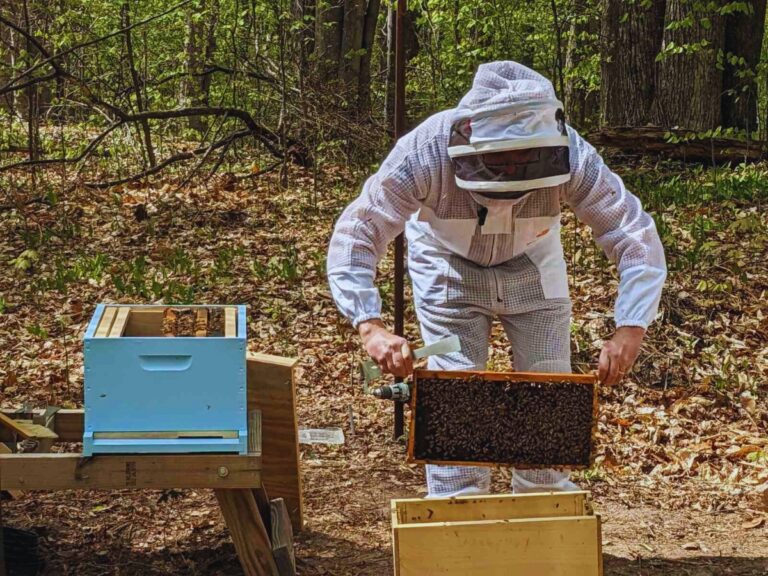
- Step-2: I open the top cover of the hive and perform a quick check around 5-10 seconds on each frame by lifting each frame with the hive tool from the honey super. If I notice these frames only contain capped broods or capped honey, I totally ignore these frames. I use a little smoke if I see bees are aggressive.
- Step-3: I go through a top-to-bottom approach that is box by box from the top down to the bottom. For each frame, I spend around 10-30 seconds, 5-15 seconds for each side. I look at the 4 corners as soon as I lift up the frame, as the queen will try to hide on the opposite frame or at the edges of the frame. Then I look at the other parts of the frame on each side.
- Step-4: When lifting frames, if I see frames containing mostly newly born broods, or lots of brood bees, I give high priority to that frame. I observe the whole frame carefully and look for the largest bee with caramel color surrounded by attendants facing towards her.
- Step-5: If there is any queen cell, I look for if there is any newly born queen brood present. If the queen cell is empty, that means the newly born queen is already killed by the existing queen, or the old queen is replaced by the new queen.
- Step-6: I open each frame on each box and decide within 2-3 seconds whether to check this frame or skip it. After deciding and performing an inspection, I kept it side by side out of the hive and went to the next frame.
- Step-7: I look for frames containing broods, frames with fresh eggs standing upright, frames with young larvae, and frames with a mix of capped and open broods.
- Step-8: After I identify the queen, I look for other important signs during hive inspection, then close the hive. This completes my hive inspection and queen identification.
Note: There is a high chance for the queen to be in the center brood frames in the lowest brood box. Spend some extra seconds on the particular brood frames.
Practice makes a man perfect. So, don’t worry if you don’t find the queen in your first attempt.
Close the hive and wait for 7-8 days. Perform an inspection again and look for the queen. With time, you will discover your own technique of identifying the queen bee in a beehive.
The “split and coffee” Trick (multi-box hives)
This one is an interesting technique for queen identification performed by expert beekeepers. This “split and coffee” trick works for multi-box hives. This reduces the time to half for hive inspection, focusing on queen identification.
Here is how it works.
- Take the upper half of the hive and put it beside the lower half of the beehive.
- You can go for a cup of coffee or spend around 10-15 minutes.
- Come back and look for the part of the beehive that has more bee traffic compared to the other. The queen is suspected to be in the heavy traffic half of the beehive.
This technique works most of the time. It also reduces your hive inspection to half, as you are completely ignoring one half of the hive from inspection by frames.

KINGLAKE J Hook Hive Tool — Frame Lifter & Scraper
Stainless steel J hook design — ideal for prying apart frames, opening candy plugs, and scraping wax during hive inspections.
See Price on Amazon →
Expert Tips on How to Identify the Queen In a Beehive
Here are some tricks that will help you to easily identify the queen during your next hive inspection.
- If you got the queen in a cage or with your bee nuc, make sure she is marked. The marked queen is easier to identify as she is marked with a color on her back.
- Try to remember her pattern after you identify her for the first time. Her appearance, attendance, and behaviour of workers around her.
- Use a good-quality marker to mark her for easy identification. After marking her put her in a cage for a while before releasing her.
- If you are using a queen excluder to rear queens for commercial purposes, follow proper color codes for marking the queen.
- Learn brood patterns and priorities, which frames to look carefully at and which frames to avoid. This saves lots of time.
Mark Your Queen, Spot Her Instantly

Uni Posca Medium Marker (White) — Perfect for Queen Bee Marking
Non-toxic, opaque ink that stays visible on the queen’s thorax — water-based and safe for bees, dries quickly for easy identification during hive inspections.
See Price on Amazon →
Frames Unlikely to Have the Queen
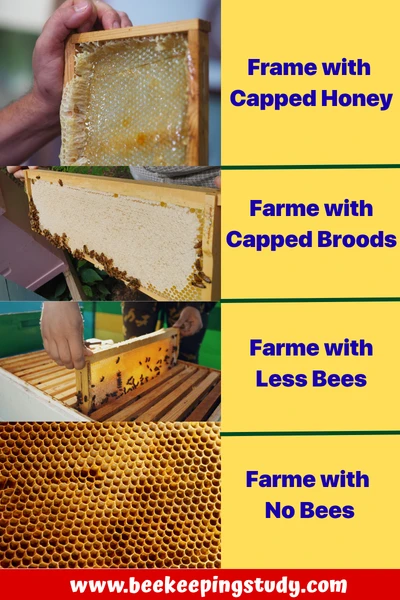
The queen is unlikely to be in some frames. Here are the common frames where you might not expect the queen to be.
- Frames in honey super (If no queen excluder is present there)
- Frames with completely capped honey or capped broods.
- Completely empty frames.
- Undrawn foundation frames.
- Frames with only a very few worker bees.
Frames Most Likely to Have the Queen
These are the places where the queen is most likely to be present.
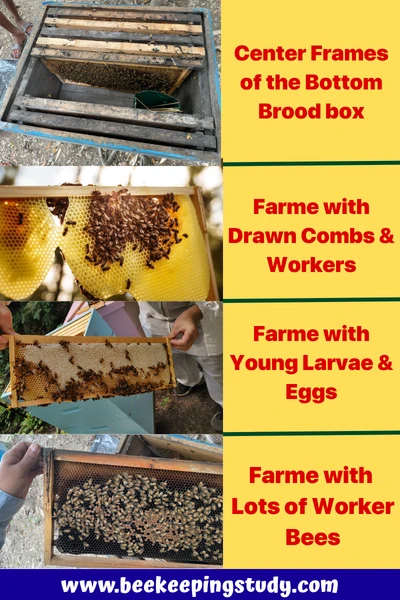
- Center frames of the bottom brood box.
- Frames with lot of worker and brood bees.
- Frames with younger larvae and eggs.
- Frames with combination of capped and uncapped broods.
- Frames with worker and drawn combs.
Seasonal Checklist: Where to Look for the Queen
- Early Spring: Start in the upper brood box — the queen has been laying inside the winter cluster all season. Check the 2–3 center frames there first before going lower.
- Late Spring (Swarm Season): The brood nest is expanding downward — prioritize center frames of the bottom box. If a swarm just left, look for a fast-moving virgin queen on brood frames with open cells.
- Summer (Peak Flow): Check the center frames of the bottom brood box between 10 AM and 2 PM when foragers are out. Focus on frames with the most open cells — she moves to wherever there is room to lay.
- Late Summer / Early Fall: The brood nest is contracting — she is concentrated on just a few active center frames in the bottom box. If the nest is honey-bound, check edge brood frames too as she searches for open cells.
- Winter: Do not inspect for the queen directly. Instead, confirm her presence in early warm spells by checking center frames of the upper box for fresh eggs — one egg per cell means she was active within the last two days. A queenless colony during winter is in danger. Thus queen presence is very important for the survival of the colony throughout the winter.
Note: During winter bees are extremely busy on keeping the colony warm. Thus it is important to winterize the beehive properly before the winter. Try not to inspect the hive during winter.
Queen Identification & Hive Inspection Essentials

Outus Queen Clips & Marking Bottle — 5 Pcs Transparent Bee Cages
Safely catch and hold the queen for marking — includes marking bottle for easy color application
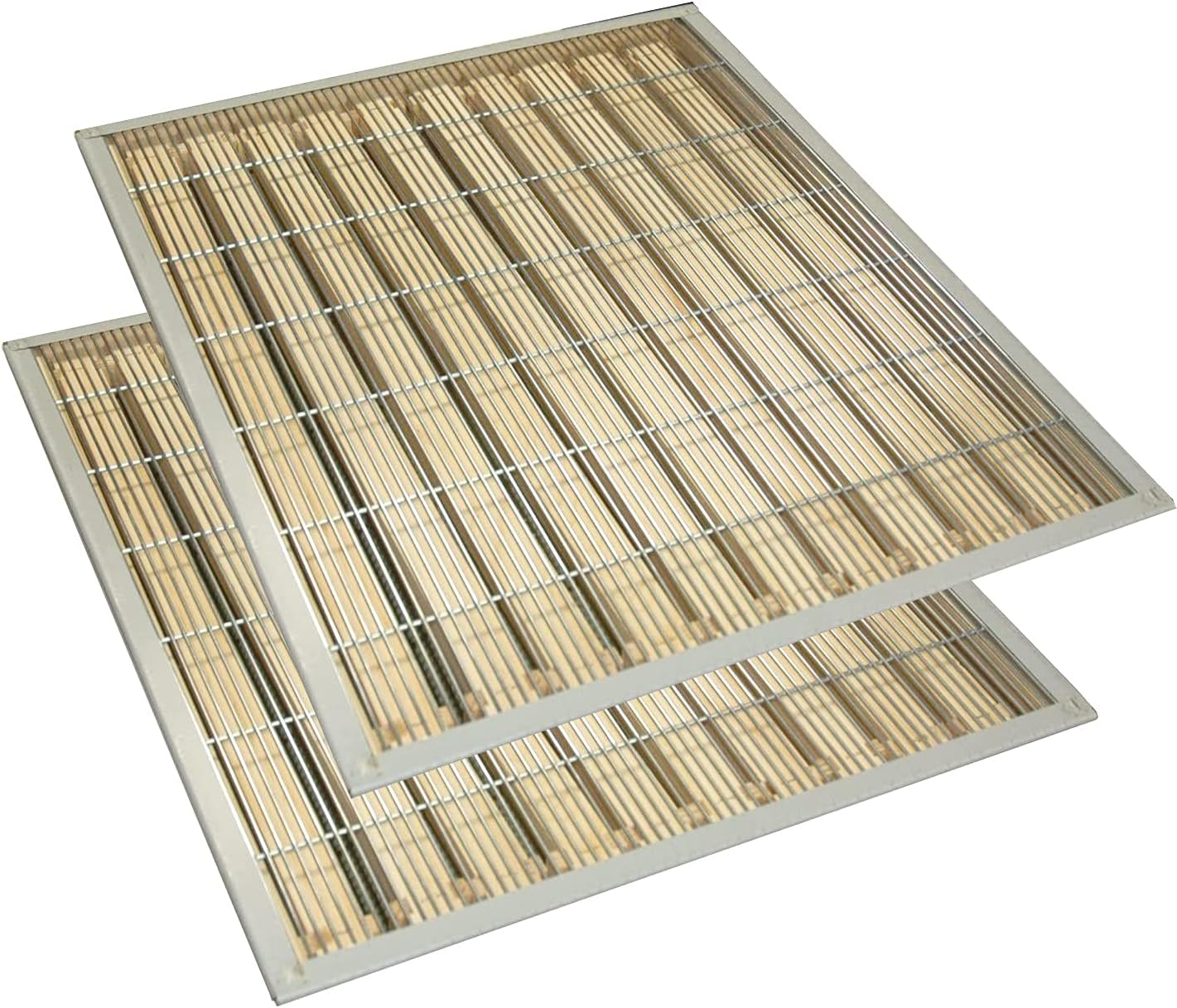
BEEXTM Metal Queen Excluder — 10 Frame, 2-Pack
Keeps the queen in the brood box — essential for multi-box hives and queen rearing

Bee Hive Smoker — Stainless Steel with Heat Shield
Use a little smoke before inspection to calm aggressive bees — makes queen spotting easier
Frequently Asked Questions
How to tell if a bee hive has a queen?
The most reliable sign is the presence of fresh eggs standing upright in cells - if you see them, the queen was active within the last three days. You should also see a consistent pattern of capped brood across the center frames.
Can I split a hive without finding the queen?
Yes - shake all the bees off the frames you want to move into the new hive, which leaves the queen behind on whichever frame she was on. Place a frame with fresh eggs and young larvae into the queenless split so the bees can raise their own new queen.
Do bees kill their queen?
Yes, bees will kill their queen when they decide she is no longer fit to lead the colony - typically when her egg-laying rate drops or her pheromone production weakens with age. Workers will swarm tightly around her in a behavior called "balling," generating enough heat to kill her.
Quick Summary
It is important to have the skill to identify the queen bee in a beehive. Because a stronger queen means a stronger honey bee colony. Spend more time learning brood patterns, queen rearing, and understanding your honey bee colony behaviours.
Here is a final quick reference summary on how to identify the queen bee in a beehive.
| Frame Type | Queen Likelihood |
|---|---|
| Outer / wall frames (honey storage) | ❌ Very Low |
| Fully capped honey frames | ❌ Very Low |
| Undrawn foundation frames | ❌ Very Low |
| Mixed capped + open brood, center frames | ✅ High |
| Frames with fresh upright eggs | ✅ Very High |
| Youngest larvae, active brood zone | ✅ Very High |
| Upper box center frames – early spring | ✅ Seasonal High |
| Lower box center frames – summer & fall | ✅ Seasonal High |
If you can see the queen is not present for long and there is no newly born queen it is an alarming sign. Make sure to requeen the queenless hive to save the colony.