This post might be created with help from AI tools and carefully reviewed by a human (Anthor Kumar Das). For more on how we use AI on this site, check out our Editorial Policy. This post may contain affiliate links. We may earn a small commission at no extra cost to you. Read our affiliate disclosure.
Queen Bee vs Worker Bee vs Drone Bee – Complete Comparison

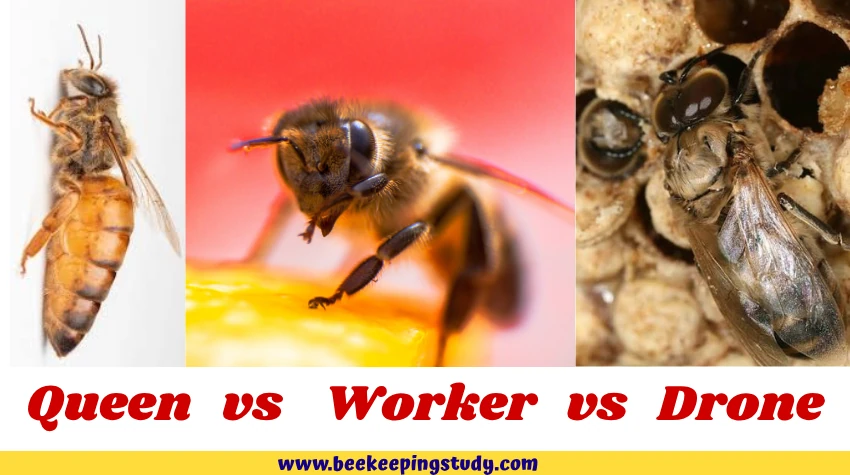
In a honey bee colony (Apis Mellifera), there are mainly 3 types of bees: the queen bee, the worker bee, and the drone bee. This article is all about these different members of a honey bee colony. We are going to explore everything we need to know regarding queen bee vs worker bee vs drone bee comparison.
Workers and the queen are female, and drones are the reproductive male members of the honey bee colony. We will explore each type of bee’s differences in role and appearance.
Queen Bee – The Mother of The Colony
A queen bee is the only reproductive female member of a honey bee colony. So, you can consider the queen bee as the mother of an entire honey bee colony. This is why people say the queen bee is the heart of the colony.
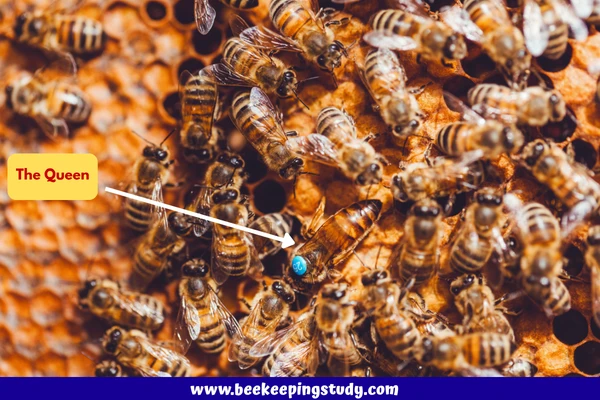
If there is no queen for a few weeks, the entire colony will die. This is why beekeepers often require requeening a queenless beehive to save a honey bee colony.
Queen Bee Appearance
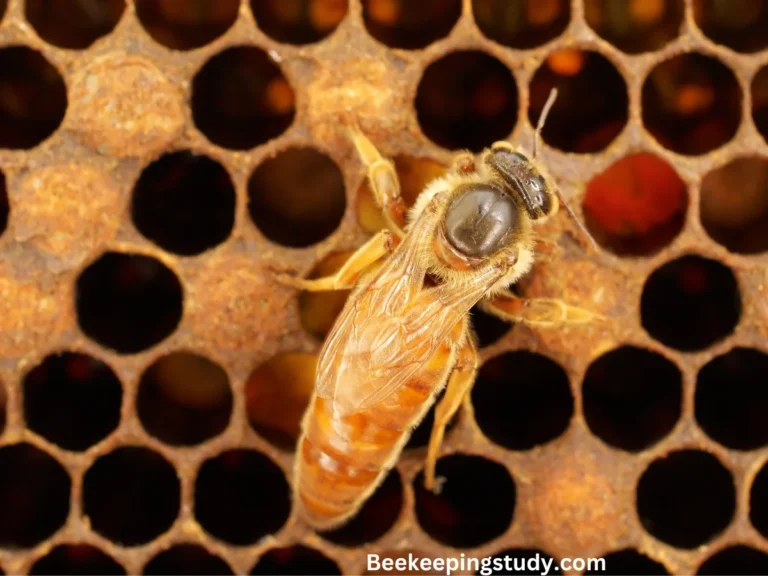
The queen bee is the single reproductive, large bee in a honey bee colony. The easiest way to spot a queen bee is by looking for a large bee with a tapered abdomen.
The most important part is her abdomen: long, smooth, and tapering to a point, extending well past the tips of her folded wings. Her wings are small, covering only two-thirds of her body.
Here are the tips for queen bee identification.
- The queen is the largest (18-22 mm) member of the colony.
- Her abdomen is tapering, shiny, with reduced striping, and less hairy.
- Legs are long and splayed.
- No pollen basket on her legs.
Pro tip: You will see some worker bees facing inward towards the queen. When the queen moves, those attendant bees move in the same direction without changing the cluster shape.
For easy identification, beekeepers often mark a queen with proper color.
Role of the Queen
The queen is the ruler and mother of the colony. At peak season, she can lay 1400 – 2100 eggs per day. Sometimes the weight of her eggs exceeds her own body weight.
She mates only once in her life, during a series of nuptial flights, coupling with roughly 10–20 drones and storing 5–7 million sperm in an organ called the spermatheca. After mating once, she lays eggs for years from those stored sperm.
She distributes workers’ tasks and coordinates the entire colony through queen mandibular pheromone (QMP).
Worker Bee (Lifetime Hardworker)
Workers are all the infertile female members of the colony. Around 95% of the honey bee colony members are worker bees.
They do all the work for the overall security and development of the colony. You can say they do everything excluding reproduction.
Worker Bee Appearance
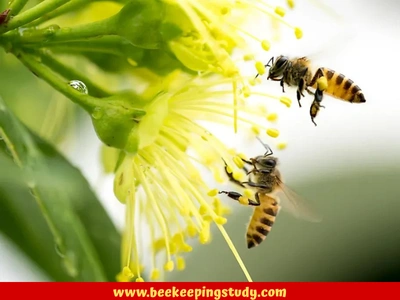
Worker bees are the smallest (10-15 mm) in size in a honey bee colony. Here are other easy identification tips:
- Fuzzy, hairy thorax, and a rounded abdomen tip.
- Clear black-and-amber banding on the abdomen.
- Wings cover most of the abdomen.
- Have a sharp and barbed stinger.
- Have a pollen basket on the hind legs. Often visible when coming from outside, packed with a colored ball of pollen (yellow, orange, even blue).
Worker Bee Roles
As I already said, they do everything except mating and reproduction. Their roles change with age in a pattern called temporal polyethism, which is as below:
- Days 1–3: Cleaning and polishing brood cells
- Days 3–11: Nurse bees – feeding larvae (they visit each larva up to ~12,00-1,400 times a day)
- Days 12–17: Producing wax, building comb, storing nectar and pollen
- Days 18–21: Guarding the hive entrance
- Day 22 to death: Foraging for nectar, pollen, water, and propolis
Each worker bee produces around 1/12 teaspoon of honey in its lifetime. The barbed stinger is deadly for them. It is used only for defensive purposes. Once the worker stings, the stinger is detached from the body, and it dies within a few seconds or immediately.
This means they will only use their sting when they smell any danger to the colony. Whenever any danger is spotted, they won’t hesitate to sacrifice their life and attack the suspect. True patriotism isn’t it?
Drone Bee (All the Male Bees)
Drones are developed from unfertilized eggs. They carry half the chromosomes of females, as they don’t have a father. Drones are fed by the workers, as they are unable to feed themselves.
Drone Bee Appearance
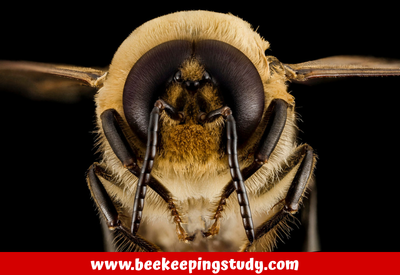
Drones are unmistakable due to their large eyes and blunt rear end.
- The single most unique feature of them is enormous eyes that meet at the top of the head.
- Bulky body with a broad thorax.
- Blunt, rounded, square-tipped abdomen.
- No stinger.
- No pollen basket.
- Wings reach or even past the end of the abdomen.
- During flight, they are large and noticeably louder.
Drone Bee Role
A drone’s only biological function is to mate with a virgin queen during mating flight. Drones also mate only once or never in their lifetime.
After mating, it dies as its reproductive apparatus is torn apart from its body. The others those failed to mate during the mating flight dies itself by falling to the ground.
Those that weren’t in the mating flight are also expelled from the hive by the workers in autumn to preserve the winter food store.
Queen Bee vs Worker Bee vs Drone Side-by-Side Comparison
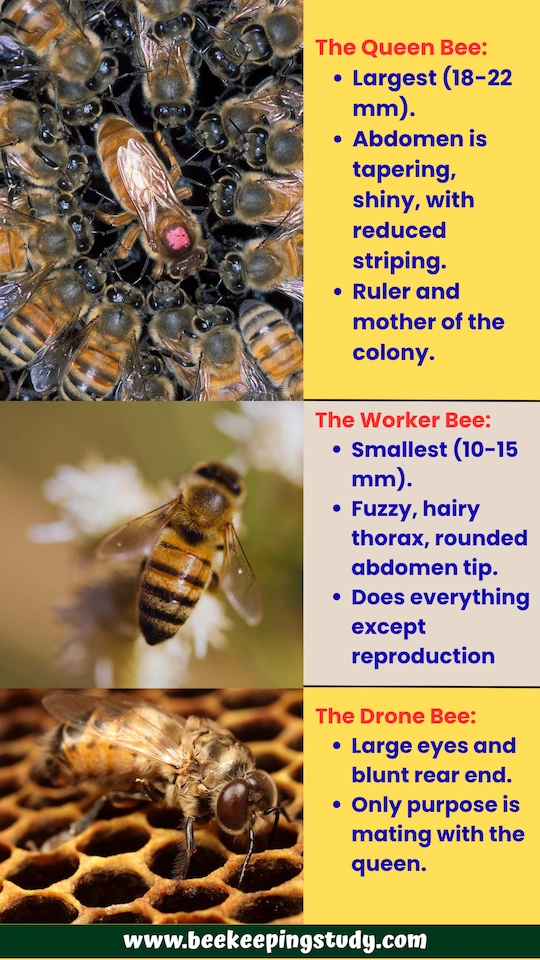
So far you have learned about all 3 types of members of a honey bee colony. Here is a complete comparison among queen bee, worker bee, and drone bee.
| Feature | Queen | Worker | Drone |
|---|---|---|---|
| Sex | Female (fertile) | Female (sterile) | Male |
| Number per colony | 1 | 18,000-65,000 (up to ~80,000 in peak summer) | A few hundred to ~2,000 (seasonal) |
| Body length | 18-22 mm | 10-15 mm | 15-17 mm |
| Body weight (approx.) | ~160-300 mg | ~80-100 mg | ~180-250 mg |
| Genetics | Diploid (32 chromosomes) | Diploid (32 chromosomes) | Haploid (16 chromosomes) – from unfertilized egg |
| Brood Lifecycle | ~16 days | ~21 days | ~24 days |
| Larval diet | Royal jelly (entire life) | Royal jelly (3 days), then “bee bread” (pollen + honey) | Royal jelly (3 days), then bee bread |
| Stinger | Yes – smooth, reusable (Very rarely used) | Yes – barbed, dies immediately after stinging | None |
| Eyes | ~3,000-4,000 ommatidia | ~4,000-7,000 ommatidia | ~7,000-8,500 ommatidia (huge, meet at top of head) |
| Lifespan | Usually 1-5 years (occasionally up to 7) | Summer: 4-8 weeks; Winter: 4-6 months | ~ 6-10 weeks (die after mating or evicted before winter) |
| Pollen baskets (corbiculae) | No | Yes | No |
| Can forage/make wax? | No | Yes | No |
Quickest Way to Tell Them Apart
If you are inspecting a honey bee colony and looking for the quickest identification, here is how you can decide.
- Small, fuzzy, striped, wings covering the lower part of the body, busy, and in some cases may be carrying pollen? -> Worker bee.
- Large eyes touching at the top, wings almost past the abdomen? -> Drone bee.
- Largest one with long, pointed abdomen, and wings not reaching the end, some bees facing inwards towards her? -> Queen bee.
Final Takeaways: Every Bee is Crucial for The Honey Bee Colony
So far, you have understood the difference among the queen bee, worker bee, and drone bee. Every type has a distinct mandatory need for the colony. One can’t survive without the other type.
One (Queen) bee reproduces and leads the colony, a few hundred (drones) are responsible purely for genetic dispersal, and a few thousand (Worker) for all the labor and defense. The contribution of each of those led to a strong, healthy, and beautiful social colony.
Two important factors.
- Castes in females are determined by diet (Queen = only royal jelly; Worker = Royal jelly and bee bread).
- Sex is determined by fertilization (fertilized = female worker or queen bee; unfertilized = male drone bee).
Learning about honey bees and their life cycle is never-ending. These tiny, beautiful, blessing creature is very crucial for our ecosystem. We should always try to help the bees in different ways if possible.
Important Lesson: The honey bee hive teaches us that unity can turn weakness into strength. Because A thriving hive is built by many small efforts moving in the same direction.