This post might be created with help from AI tools and carefully reviewed by a human (Anthor Kumar Das). For more on how we use AI on this site, check out our Editorial Policy. This post contains affiliate links. We may earn a small commission at no extra cost to you. Learn more.
How Much Honey Does One Beehive Produce Per Year
When I got my first hive, I had one big question in my head. How much honey does one beehive produce in a season?
I quickly learned that there is no single number that fits everyone. Some years, one hive surprised me with a big crop. Other years, I harvested very little, and that is still normal.
In this guide, I will explain average honey production per hive in a simple way. You will learn what changes honey yield the most, how much you can harvest without harming the bees, and how to estimate your own hive’s output.
By the end, you will have a clear idea of what to expect from honey farming. You will also know how to help your hive produce more honey while keeping it healthy.
So, how much honey does a beehive produce on average? Here is the realistic range I often see and discussed by other backyard beekeepers.
- Hobby hive: About 20 to 60 pounds of honey in a season.
- Strong hive in a normal year: About 60 to 100 pounds.
- Great nectar flow year: About 100 to 200 pounds or more, if the hive is very strong and managed well.
A first-year hive usually makes less because it spends a lot of time building comb and growing bees. A well-established hive often produces more in year two and beyond.
How Much Honey Does One Beehive Produce Per Year
Average honey production depends on your local nectar flow and how strong your colony is. When people say “average,” they often mean a normal season with no major swarming, no heavy pest pressure, and decent weather.
Typical Yield Ranges
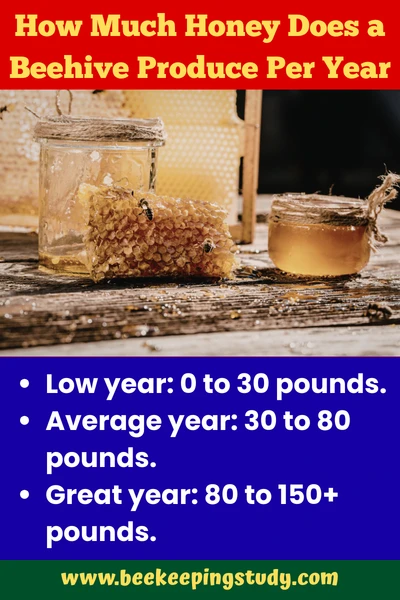
When it comes to the question of how much honey does a beehive produces in a year, the typical answer is 30 to 80 pounds. Here are the typical ranges.
- Low year: 0 to 30 pounds. This can happen with bad weather, weak forage, swarming, or pests.
- Average year: 30 to 80 pounds. Many backyard hives fall into this range.
- Great year: 80 to 150+ pounds. This usually needs a strong spring build-up and a long nectar flow.
Pro tip: When you hear “average” think of a middle result, not the best result. It is the kind of harvest a healthy hive can do most years in that area.
First-Year Hive vs Established Hive
Most beginners skip this when learning beekeeping. First-year hives often produce less for a simple reason. They are busy building the colony from scratch.
- They need time to draw combs. Drawing comb uses a lot of energy and nectar.
- The population is smaller early on, so there are fewer foragers bringing nectar.
- New beekeepers also tend to be cautious and may harvest less, which is smart.
In my first year, I harvested only 40 pounds of honey. Because I was worried whether honey bees have enough storage for winter or not.
In year two and beyond, a good hive usually performs better.
- It has drawn a comb ready.
- It can build up faster in spring.
- It can take advantage of nectar flow earlier.
Many beekeepers notice the real honey crop starts from the second season if the colony stays healthy. I harvested 110 pounds of honey from a single beehive in my second year of beekeeping.
How Much Honey Can You Harvest From a Hive Without Harming the Bees
This is the part most new beekeepers worry about. I worried too. I wanted honey, but I did not want to starve my bees.
The simple truth is this. Bees need their honey to survive winter and also to get through weeks when the weather blocks foraging. Rainy days, cold snaps, and drought can all stop nectar from coming in. Thus, we need to help bees by not harvesting too much.
Leave-Behind Rule (Simple and Safe)
I follow a simple mindset instead of chasing a fixed number. Harvest only the honey your bees can spare after you are confident they have enough stored food.
- Harvest from capped honey: If it is not capped, it may not be ready and your bees may still need it. Don’t mess up between capped honey and capped broods.
- Never take brood area food: The brood nest needs nearby honey and pollen to raise healthy bees.
- Think in safety buffer: Leave extra stores for bad weather weeks. Bees can burn through food faster than you expect.
- If you feel unsure, take less: You can always harvest later. Fixing starvation is harder.
A safe rule for beginners is simple. Take some honey only after you can clearly see the colony has heavy stores left across multiple frames.
Important Info: I prepared a beekeeping income opportunity calculator. Use this beekeeping profitability calculator to get idea how much you can expect from your apiary.
Honey Quality vs Quantity
It is tempting to chase the biggest harvest. But too much focus on quantity can stress the hive and lower honey quality.
Why chasing max yield can backfire
- Less food for bees: Taking too much can force heavy feeding and weaken winter survival.
- More stress and robbing risk: Over-harvesting can leave hives vulnerable during dearth periods.
- Rushed management: Pushing colonies hard can increase swarming pressure or pest issues.
Moisture, ripening, and capped honey
- Ripened honey matters: Bees reduce moisture and add enzymes before honey is ready.
- Capped honey is the best sign: When cells are capped, honey is usually properly ripened and stored.
- High moisture can ferment: Uncapped honey can be too wet. That can cause spoilage after harvest.
My simple rule is this. Harvest less if needed, but harvest better. Let the bees finish the job and cap the honey before you take it.
How Much Honey Do Bees Need To Survive Winter
Instead of only thinking in pounds, it helps to think in frames. You can open the hive quickly and see what you have.
- Warm climates: Many hives can do fine with about 4 to 6 deep frames of honey stored, or around 30 to 60 pounds.
- Moderate winters: A common safe range is 6 to 10 deep frames, or around 50 to 80 pounds.
- Cold climates with long winters: It is safer to aim for 8 to 12 deep frames, or around 70 to 100+ pounds.
These are rough ranges, not strict rules. How much you need depends on winter length, hive size, and how well your hive stays dry and draft-free.
If you live in a warm area, bees may still fly on many winter days, so they often need less stored honey. In colder regions, bees may cluster for long periods and must rely almost fully on stored honey.
How Does the Number of Bees in a Hive Impact Honey Production
I used to think honey production was only about flowers. Then I saw a strong, crowded hive outproduce a weaker hive in the same yard. That is when it clicked. Honey is mainly about how many healthy foragers you have during the nectar flow.
Foragers vs Nurse Bees
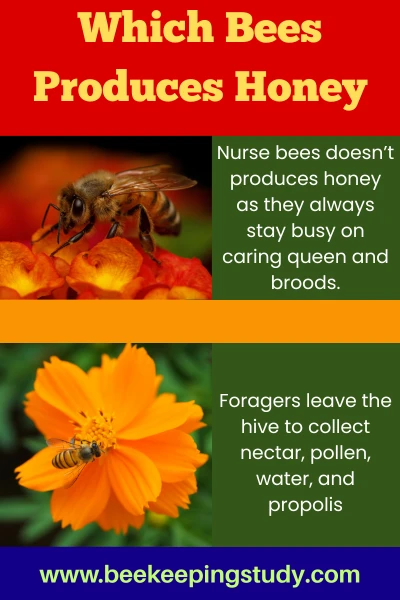
Not every bee collects nectar. Bees change jobs as they age.
- Nurse bees: These are younger workers. They feed larvae, tend the queen, and support brood growth.
- Foragers: These are older workers. They leave the hive to collect nectar, pollen, water, and propolis.
A hive needs both. Nurse bees raise the next generation. Foragers bring the nectar that turns into honey.
How Much Honey Does a Bee Make
This part always surprises people. A single worker bee makes only a tiny amount of honey in her lifetime.
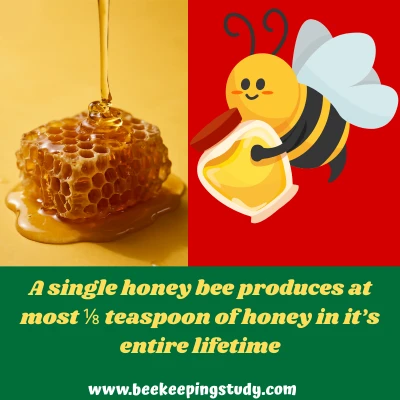
A common way to explain it is this. It takes thousands of bees working together to make the jars we enjoy. One bee may only contribute a very small fraction of a teaspoon across her whole life.
So honey is not a one-bee product. It is a full colony achievement, built through teamwork and long hours of foraging.
Why a Crowded, Healthy Hive Collects More Nectar
- More foragers: A larger population means more bees can go out and bring nectar back.
- Better heat control: Strong colonies keep brood warm and stable, which supports steady growth.
- Faster comb work: Crowded hives draw comb and cap honey faster during a strong flow.
Healthy matters as much as crowded. A packed hive with mites or disease can still underperform. Strength plus health is the best combo.
Calculating Honey Production Estimation
If you want to estimate honey production, frames are the easiest unit. You can look inside and make a quick guess without weighing everything.
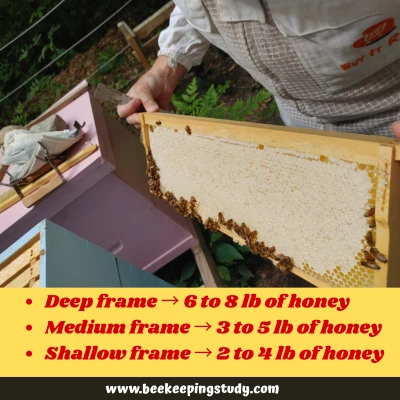
Simple Estimation Method (Frames to Pounds or Kg)
Use capped honey frames as your main unit. Capped honey is usually ripe and ready. Uncapped nectar can be too wet, so I do not count it as full honey.
- Deep frame: A fully capped deep frame often holds about 6 to 8 lb of honey (about 2.7 to 3.6 kg).
- Medium frame: A fully capped medium frame often holds about 3 to 5 lb (about 1.4 to 2.3 kg).
- Shallow frame: A fully capped shallow frame often holds about 2 to 4 lb (about 0.9 to 1.8 kg).
These are estimated ranges based on my colonies, not perfect numbers. Frame size, comb depth, and how evenly it is capped can change the weight.
Quick example calculation
Let’s say you have a medium super with 8 capped frames.
- If each capped medium frame averages 4 lb, then 8 frames are about 32 lb of honey.
- In kg, 32 lb is about 14.5 kg.
If only half the frame face is capped, I count it as half a frame. That keeps my estimate more realistic.
Season Tracker (My Simple Notes)
I keep a simple weekly note. It helps me understand why a hive did well or why it did not.
- Bloom: What is flowering this week, and how strong does it look?
- Weather: Rainy days, wind, heat waves, or sudden cold.
- Hive weight feel: I lift the back of the hive slightly to feel if it is getting heavier or lighter.
- Supers added: When I added a new super, and how fast the bees started using it.
- Swarm signs: Any queen cells or overcrowding signs.
Expert Beekeeper Tips to Enhance Honey Production
Honey comes easiest when you have the right honey bee type, the hive is strong, healthy, and has space at the right time. These are the tips I repeat again and again for healthy honey harvest throughout the years.
- Add supers early enough: Give space before the hive gets crowded. When supers go on late, bees may store nectar in the brood area, and swarm pressure rises.
- Reduce swarming pressure: Manage space, remove swarm cells when needed, and consider splits if the hive is booming. A swarm can cut your honey crop fast.
- Keep mites and beetles low: Mites and beetles weaken foragers and shorten their lifespan. Lower mites usually mean a stronger workforce during nectar flow. Remove beetles early from the beehive to keep the colony strong.
- Replace old comb: Old, dark comb can reduce brood health and space efficiency. Rotating in fresh frames over time can help colony strength. In case, you have moldy frames you can still harvest honey safely following simple rules.
- Provide a water source: Bees use water to cool the hive and thin honey. A steady water source keeps them from wasting time searching far away.
- Proper Hive Placement: Beekeeping is rewarding, and honey production is also maximized if the beehive is in a perfect spot. So, you have to choose the right spot to place your beehive.
My personal focus is simple. Strong bees first. Space at the right time. And pest control before problems get big.
Honey Yield by Region and Climate (Cold vs Warm Areas)
The same hive design can produce very different honey depending on where you live. I have seen beekeepers in warm regions talk about multiple nectar flows. In colder regions, some beekeepers get one big flow, and that is it.
Cold climates
- Shorter season means fewer foraging days.
- Bees use more stores to keep warm, so less surplus may remain.
- A long wet spring can delay build-up and reduce the main honey crop.
Warm climates
- Longer season can mean more chances to collect nectar.
- Some areas have multiple flows, so hives can store honey more than once.
- Heat and drought can still reduce nectar, even when flowers are present.
So if your friend in another region says they get 150 pounds per hive, it does not mean you are doing something wrong. Their climate may simply offer more nectar days.
Common Mistakes That Cut Honey Yield
I made some of these mistakes early on. They are common, and the good news is they are easy to fix once you notice them.
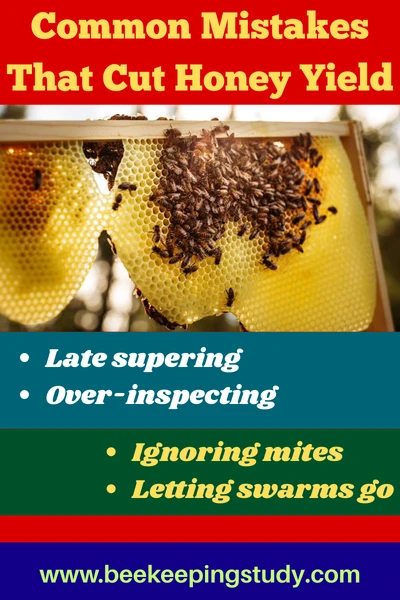
- Late supering: If you add supers too late, the hive gets crowded. Crowding increases swarming risk and can slow nectar storage.
- Over-inspecting: Long and frequent inspections break the hive rhythm. Bees spend time defending and re-organizing instead of foraging.
- Ignoring mites: Varroa lowers bee lifespan and reduces forager strength. That can quietly cut honey without obvious signs.
- Letting swarms go: A swarm takes a big chunk of your workforce away. Your honey crop often drops right after.
Signs Your Hive Will Produce a Good Honey Crop This Year
You can often tell early if a hive is setting up for a good season. I watch these signs during spring and early summer.
- Strong brood pattern: Solid capped brood and eggs mean the colony is building a large workforce.
- Heavy incoming pollen: Bees bringing pollen often means brood rearing is strong and forage is active.
- White wax on frames: Fresh white wax usually shows strong nectar coming in and comb building.
- Bees filling supers: When bees start storing nectar and capping quickly, the flow is on and the hive is ready.
- Calm busy behavior: You see steady traffic at the entrance without constant fighting or robbing.
The Future of Sustainable Honey Farming
Honey production is tied to the health of the land. When forage improves, bees do better. When forage declines, even great beekeeping cannot fully fix it.
Simple Ways to Support Sustainable Honey Production
As a beekeeper, we can support sustainable honey production by doing these simple things.
- Plant for pollinators: Choose local nectar and pollen plants that bloom across spring, summer, and fall.
- Reduce pesticide exposure: Avoid spraying during bloom. If you must spray, do it late evening when bees are not flying.
- Support local forage: Even a small patch of flowering plants near an apiary can help during dearth periods.
Climate Change and Shifting Nectar Flows
Many beekeepers are noticing changes. Bloom times can shift earlier or later. Drought can reduce nectar. Sudden storms can cut foraging days. This is why tracking bloom and weather each season helps. It shows you what changed and how to adjust next year.
Frequently Asked Questions
Many first-year hives produce less honey because they spend time building comb and growing the colony. In many cases you might harvest 0 to 30 pounds, and sometimes none. That is fine if the bees are building strong for the next season. Flow Hives can make harvesting easier, but they do not create extra nectar. Honey yield still depends on forage, weather, and hive strength. A Flow Hive can do well if the colony is strong and the nectar flow is good. A full super usually means most frames are drawn and filled with honey. Many beekeepers consider a super “full” when the majority of frames are mostly capped. For estimating, medium supers often hold roughly 30 to 50 pounds when filled and capped, depending on frame count and comb depth.How much honey can I harvest in the first year?
Do Flow Hives produce more honey?
How many frames of honey is a full super?
Final Thoughts
So, how much honey does one beehive produce? It depends on your region, nectar flow, and how healthy the colony stays. Focus on strong bees first. Honey comes second.
Give your hive space on time, keep pests low, and avoid pushing the colony too hard. Harvest only what they can spare, and always leave enough for winter and bad weather weeks.
If you want, share your region and your average honey yield in the comments. I would love to compare notes and learn what works best in different climates.