This post might be created with help from AI tools and carefully reviewed by a human (Anthor Kumar Das). For more on how we use AI on this site, check out our Editorial Policy.
How Much Do Beekeepers Make (A Comprehensive Estimation)
If you are thinking of starting beekeeping for a living, your first question would be, ‘How much do beekeepers make‘ on average per year? This would help you get an idea of how much you can expect from beekeeping.
Listen, there is no exact beekeeping profit prediction because it depends on various factors.
Short Answer: You can expect, on average, $200 to $700 per year from a single hive from the second year. In the UK a beekeeper’s on average makes around £200 to £600 per year from 1 hive. For large-scale beekeeping, these earnings can be 10 times or even more.
I have talked with many beekeepers in the USA and the UK. Also, researched various beekeeping forums and groups. Finally, I prepared a beekeeping profit estimation list for USA and UK beekeepers.
In this article, I will try to share with you the following key facts.
- How much do beekeepers make?
- My beekeeping earrings.
- Factors that influence beekeeping earnings.
- How you can estimate your beekeeping earnings?
- Beekeeping earning opportunity calculator (Bonus)
- Ways to increase your beekeeping earnings.
I hope this guide will help you predict your gross income as a beekeeper.
If you are thinking of hiring some people for your commercial beekeeping. This will also help you determine your beekeeper’s salary. So, let’s dive deep into beekeepers’ profit estimation.
Do Beekeepers Make Good Money?
Beekeepers who work with a proper business plan are really making a good living. Most beekeepers start beekeeping as a hobby.
So, they are not focused on making a living through beekeeping. In their case, they may not be making a very decent amount of money. However, they still manage to make a good amount of money after years spent in this field.
But commercial beekeepers with proper plans make a huge amount of money every year.
So, if you want to start beekeeping to make a living, you have to start with a proper business plan. If you are keeping bees as a hobby, you should not think much about making money.
However, options are still available for hobbyist beekeepers to make money from bees.
How Much Do Beekeepers Make on average?
A beekeeper having 100+ hives makes an average of $6k per year. The amount of money that beekeepers make varies depending on several factors, including the region in which they live and how much honey each beehive produces on average in that region.
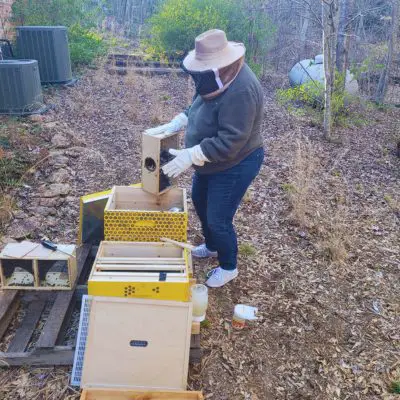
On average, beekeepers can make $200-$700 per year from one hive. So, beekeepers who have more than 100 hives can expect to make more than $5k per year. Definitely, this is not exactly what every beekeeper makes.
Beekeepers who have a small number of hives make a small amount of money. Moreover, beekeepers who do not intend to make money from bees don’t make much money. Because they are not trying all the available options to make money from honey bees.
On the other hand, a commercial beekeeper’s intention is to make as much money as possible. So, he always tries to maximize the number of hives per apiary. He also tries to manage things with proper plans so that his beekeeping cost is minimal, and his beekeeping profit is maximum.
So, the person who is keeping bees as a hobby obviously gets started with a small no. of hives. A commercial beekeeper will try to increase the no. of hives to get started in beekeeping.
So, you can easily understand that commercial beekeepers definitely make more money compared to part-time beekeepers.
Factors On Which Beekeeper’s Earning Depends
Beekeeper’s earning depends mostly on the geographical regions. Because different geographical regions have different market situations and weather conditions.
There are a few major factors on which a beekeeper’s earning depends.
- Geographic Locations: Different region has different environmental factors that influence the productivity of bees. So, beekeepers of different locations earn different amounts of money. For example: Beekeepers in the USA can make around $500 per hive. But beekeepers in Africa hardly make $250 per hive.
- Beekeepers Goal: Beekeepers who keep bees as a hobby usually don’t intend to make plenty of money. So, they are not aware of increasing the potential of income through beekeeping. But commercial beekeepers always try to manage things perfectly to increase their earnings. So, you can understand beekeeper’s earnings mostly depend on an individual’s vision and goals.
- Demand for Bee Products: In a region that has a high demand for bee products, you can expect more sales of your bee products. As a result, your earnings from beekeeping will also be higher.
- Market Situation: It is a vital factor that influences a beekeeper’s profit. Considering you are in a region where the honey price is $2/lbs you will make only $200 from 100 lbs of honey. If you can sell the honey on a market where the price is $5/lbs you will be able to make $500 from the same amount of honey.
- Mite Count: If you are in a region where varroa mites and hive beetle problems are very common, then you can’t expect to make a lot of money from beekeeping. You have to take the necessary steps first against mites, then you can expect good earnings from beekeeping.
- Competition: If you are in a region where a large group of beekeepers exists, there might be high competition. But the product demand is as usual. So, you have to find a new marketing strategy to generate more income than your competitors.
- Cost of Beekeeping: Beekeeping requires a significant amount of costs to get started. The beehive cost is the major expense when starting beekeeping. Other costs include nuc of bees, winterizing beehives, mite controls, etc. But different regions obviously require different costs. So, the profit will also vary depending on the cost of hive management.
- Ways to Make Money: There are plenty of ways to make money from beekeeping. You can earn money by selling honey, bee products, bee pollen, providing pollination services, etc. Your income depends on how many ways you are utilizing to make money.
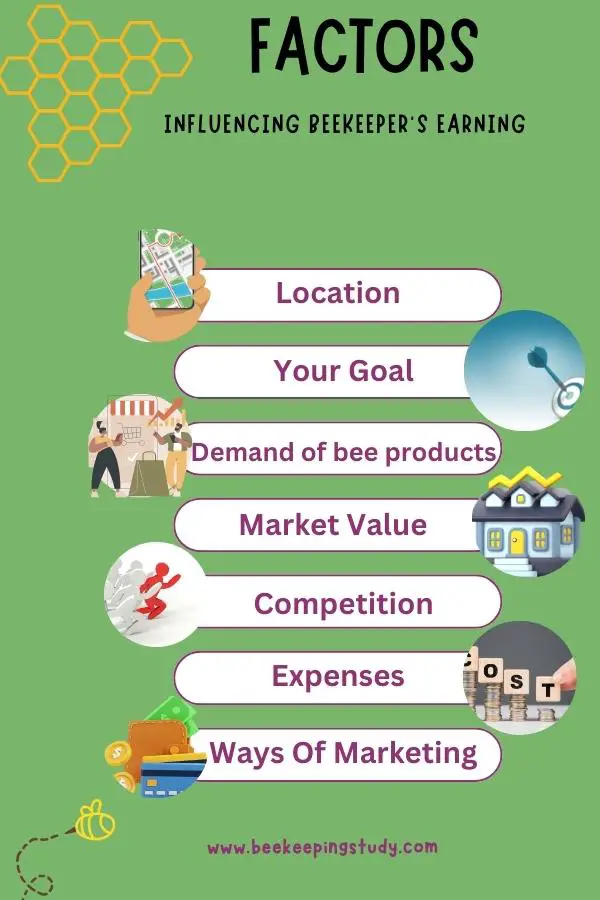
These are the major factors that vary the earnings for different beekeepers. There are definitely other factors. But the main thing is you will be able to maximize your earnings as a beekeeper by smartly managing things.
How Much Can You Realistically Expect from 1 Hive?
If you can properly manage everything, you can expect $200 to $600 or £200 to £500 per year from 1 hive. With the increase of no. of hives, your beekeeping earnings will also increase.
Note: In the first year of your beekeeping, you have to invest a lot of money. Also, you are not an expert in your first year. Thus, you can hardly expect any profit from the first year of beekeeping.
So, your earnings with 1 hive in the first year will not be much. You can expect around $100 to $300 in the USA, and around £200 in the UK from 1 hive in your first year. These earnings will vary depending on your methods of beekeeping and the type of honey bees.
Earnings from 1 hive start increasing from the second year onwards. As you have cut down your most significant investment, and your colony is stable. Exploring different methods to make money from beekeeping, your earnings start rising exponentially.
You will gain experience in how to handle things properly with time. So, your overall beekeeping earnings per hive will be increased.
Options Available to Make Money from Beekeeping
Most beekeepers do not earn “decent money” from honey alone. The beekeepers who do best usually stack multiple income streams that match their season, skills, and local demand.
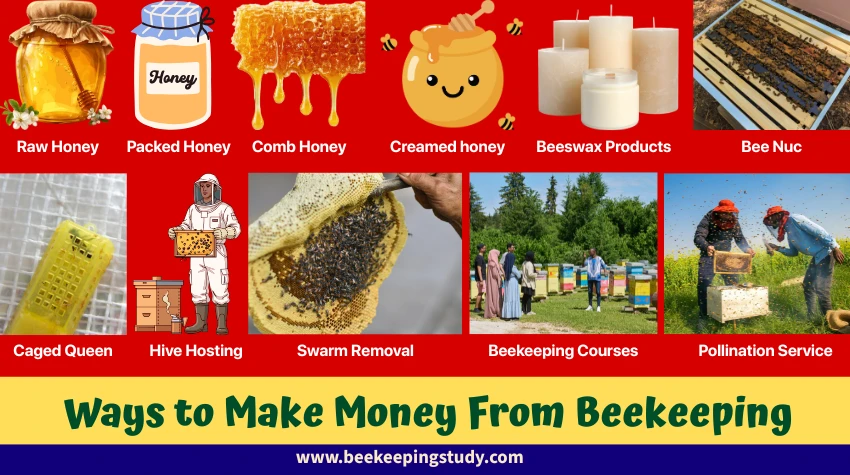
Some options work from 1 to 2 hives. Others only make sense once you have consistent colony health and more hives.
| Money Options | How it Makes Money | What You Need | Best for | Beginner Friendly? |
|---|---|---|---|---|
| Sell honey retail | Jars at local market price, direct to customers. | Jars, labels, basic bottling tools, clean handling. | Hobby and small side business. | Yes, if you have surplus honey. |
| Sell honey wholesale | Sell in bulk buckets to shops or packers. | Larger volume, food-grade buckets, consistent supply. | Bigger hobby to commercial. | Not ideal with 1 hive. |
| Comb honey | Premium product. Higher price per pound. | Comb frames, timing, careful handling. | Retail-focused sellers. | Medium. Needs strong nectar flow. |
| Creamed honey | Value-added honey with smooth texture. | Mixing process, jars, consistent batch control. | Retail and gift buyers. | Medium. Easy once you learn the method. |
| Beeswax products | Candles, balms, wraps, soap add-ins. | Wax rendering gear, molds, packaging. | Hobby to side business. | Yes. Small batches are fine. |
| Sell nucs (spring) | Sell a small colony with frames and a laying queen. | Strong overwintered hives, spare equipment, good queens. | Side business and scaling up. | Not for year 1. Great after you gain skill. |
| Queen sales | Sell mated queens during peak season. | Queen rearing skills, mating setup, consistency. | Advanced side business. | No. Learn basics first. |
| Pollination services | Rent colonies to farms for crop pollination. | Healthy colonies, transport, contracts, timing. | Usually larger operations, common in the USA. | Not for 1 hive. |
| Hive hosting / “rent a hive” | You manage hives on someone else’s land for a fee or a honey split. | Clear agreement, regular inspections, liability awareness. | Local service model. | Medium. Better after year 1. |
| Swarm removal / relocation | Charge for removing swarms, sometimes keep the bees. | Safety gear, ladder safety, local rules, experience. | Service income in swarm season. | Not ideal for beginners. |
| Workshops and beginner classes | Teach locally, charge per seat, sell starter bundles. | Strong knowledge, safe demo setup, local interest. | Community-based income. | Later. Build credibility first. |
| Content and affiliate income | Blog, YouTube, guides, affiliate links, ebooks. | Time, consistent content, real results. | Great for small scale beekeepers. | Yes, if you like creating. |
Average Earning Range Per Year for Beekeepers (USA vs UK)
Beekeeping income is highly seasonal and year-to-year volatile. Weather, nectar flow, mite pressure, and winter survival can make one year profitable and the next year disappointing. The ranges below are best read as gross income (sales), not profit.
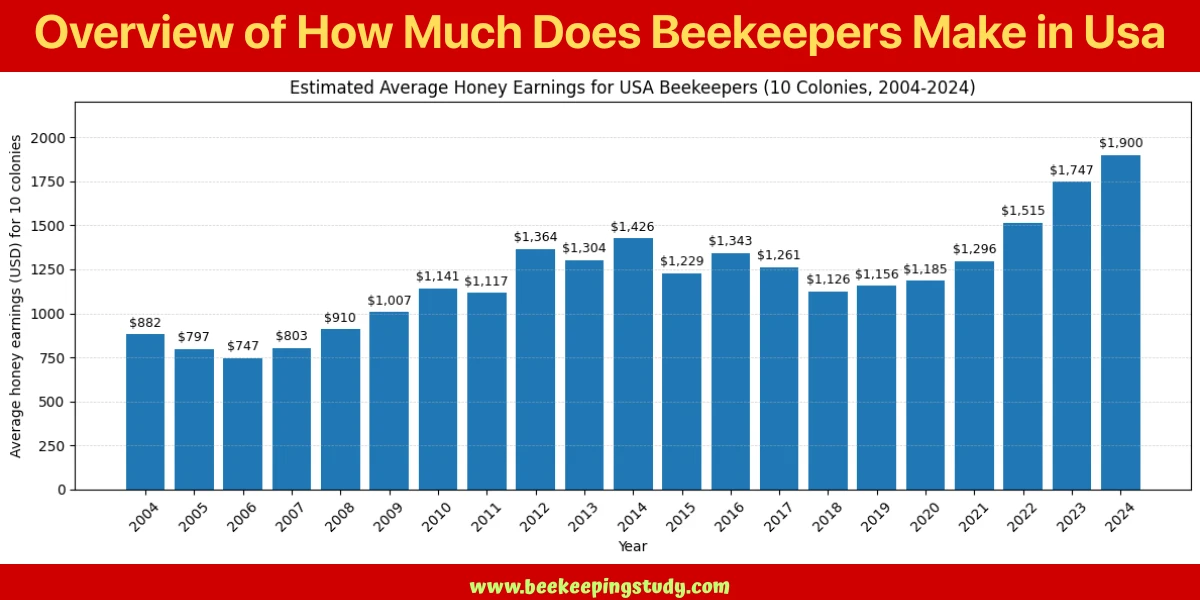
USA: Typical Gross Beekeeping Earnings Ranges (per year)
Beekeepers in the USA generate a comparatively higher income than in any other country worldwide. However, not every beekeeper’s earnings are the same. Here is a breakdown of the average beekeeper’s earnings based on the scale of beekeeping.
Hobby scale (1 to 5 hives)
Hobby scale is often considered when having 1 to 5 hives. Usually, a single person is enough for hobbyist beekeeping. Here is what you can expect as an USA hobbyist beekeeper.
- $0 to $2,000 per year is a realistic overview range.
- Many hobbyists mainly offset costs. A poor season or a colony loss can reduce earnings to near zero.
- Direct retail honey sales usually earn more per pound than bulk sales, but require time, jars, and customers.
Small Side Business (10 to 50 hives)
This category can fall under small-scale commercial beekeeping as well. Most commercial beekeepers start from this position. Here is the earnings breakdown for this category.
- $3,000 to $30,000 per year is a realistic overview range.
- At this level, income often comes from a mix of: honey, selling bees (splits/nucs), and sometimes pollination.
- Pollination can become a major revenue driver if you have strong colonies and local demand.
Commercial Scale (200+ colonies)
Commercial beekeepers are often considered professional beekeepers. Beekeepers in this category have more skills and plans to produce maximum from their colonies. Here is how much beekeepers with 200+ colonies have reported in 2025.
- $50,000 to $500,000+ per year can be possible depending on colony count, contracts, and market channel.
- The biggest gross numbers usually happen when pollination services are included (especially almonds).
UK: Typical Gross Beekeeping Earnings Ranges (per year)
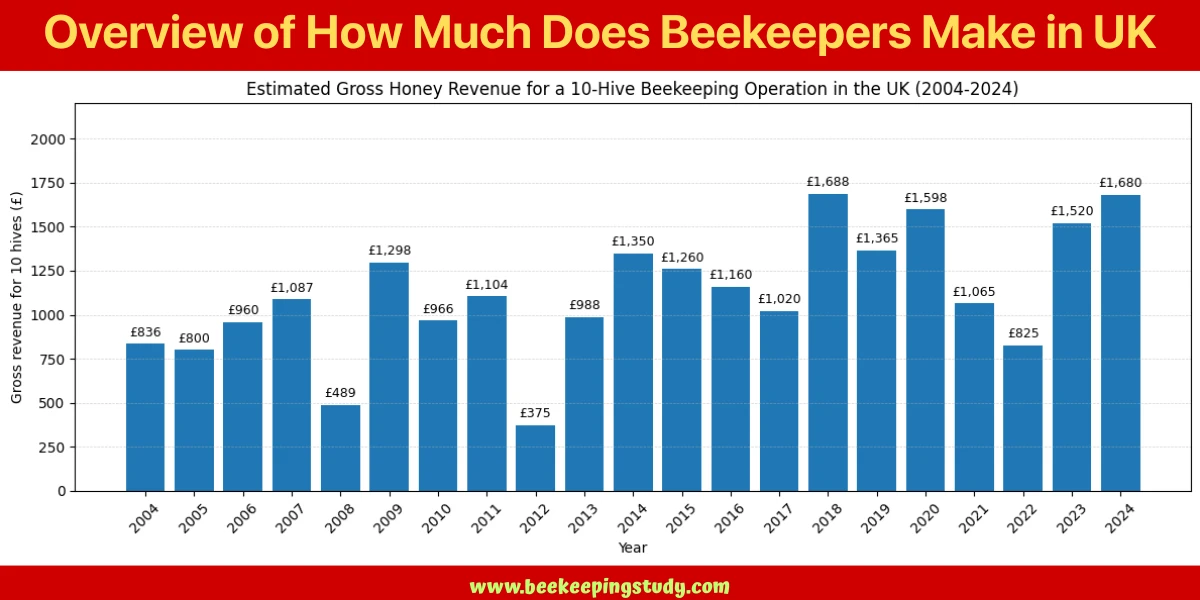
There are plenty of beekeepers in the UK regions as well. So, this estimation will also be divided into the same 3 categories.
Hobby Scale (1 to 5 hives)
- £0 to £3,000 per year is a realistic overview range.
- Many UK hobbyists treat honey sales as cost-offset rather than full profit.
- Even a single hive can produce meaningful retail income in a good year, but average surplus is often modest.
Small Side Business (10 to 50 hives)
- £5,000 to £40,000 per year is a realistic overview range.
- A common UK pattern is that selling bees (especially nucs) in spring can rival or beat honey income, once you are skilled and your colonies overwinter well.
Commercial Scale (100+ colonies)
- £30,000 to £250,000+ per year can be possible depending on scale and route to market.
- Income is usually a mix of honey, bee sales, and services.
What Usually Drives Income Beyond Honey (USA and UK)
Beekeepers in the USA and UK often maximize their incomes by using multiple of the following methods.
- Bee sales: nucs, splits, and sometimes queens (often higher-margin once you can do it safely).
- Pollination services: more common and better documented in the USA, and can be a major revenue stream at scale.
- Value-added products: creamed honey, comb honey, gift sets.
- Wax products: candles and balms can sell year-round, even if honey is seasonal.
- Local services: hive setup/management, mentoring, workshops (usually after you build credibility).
Quick Reality Check: Profit is usually much lower than gross earnings if you count all costs, and it drops further if you value your time like a business would.
My Beekeeping Earnings Story Per Year
So, you get an idea of how much beekeepers earn per year. While you are a beginner, you don’t know how much you can earn from beekeeping. So, I am going to give a quick estimation of your beekeeping earnings for the first year from my story.
I want to begin with my first-year earnings as a beekeeper. I have started my beekeeping journey with an Asian honey bee colony. Due to my mismanagement, I lost my first colony in the 5th month.
After that, I took hands-on beekeeping training from expert beekeepers in my region. Then I started another honey bee colony.
This time, I successfully managed the hive. From choosing the right place to set up my apiary to mite treatment, everything I handled was under experts with proper knowledge of beekeeping.
In the first year, I got 50 lbs of excess honey from that hive for sale. In my region, the price of honey was a bit higher. I have provided 100% solid honey.
I sold that honey $6/lbs. In total, I made $300 in my first year by just selling honey. I got a high price because I sold that honey through my father’s grocery shop directly to local consumers.
In the next year, I started selling bee pollen, wax, and other bee products. Also, every year, my colony number is increasing.
Currently, at the end of 2025, I have 400+ honey bee colonies of different species (Apis mellifera and Apis cerena). I also have 8 members for managing my apiaries. After deducting all the managerial costs and salaries of my employers, I am making around $2k/month.
Because in my region, the price of bee products and honey is high. Also, the competition is lower. So, this may not going to be the same for you.
How to Estimate Your Beekeeping Earnings
Here is a basic idea of how you can estimate your beekeeping earnings. Considering you are getting started with a single hive.
- A honey bee colony can produce 50 to 100 lbs of honey per year. Considering you are getting 50 lbs of excess honey for sale.
- Assuming the price of honey is $4/lbs. So, you will make $4×50=$200 by selling honey.
- You can also sell beeswax from that hive at a cost of around $100.
- If possible, collect bee pollen using pollen traps and sell it. You can get on average $2 for 200 gm of bee pollen.
- You can also sell propolis, royal jelly, bee nuc, extra queen bee, etc.
So, if you can manage well, you will be able to make around $500 on average every year from beekeeping.
You can also earn some extra money by providing pollination services, selling nucs, and from plenty of other sources. The picture below gives a basic estimation of earnings as a beekeeper per year from one hive.
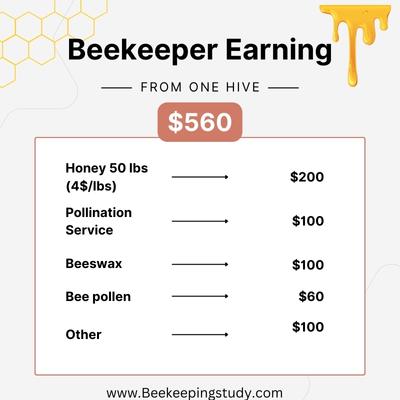
The larger your colony size, the more you earn. Just learn when and how to expand your colony to make the most out of beekeeping.
Bonus: Doing research online and consulting with multiple beekeepers of USA and UK I prepared a calculator. You can use this beekeeping profitability calculator to get idea how much profit you can expect from honey farming.
Tips to Increase Your Earnings From Beekeeping
Increasing income from beekeeping usually comes down to two things:
- Keeping colonies healthy and productive, and
- Choosing the right way to sell what you produce.
Below are practical, proven tips that work for hobbyists and small side businesses.
1) Keep Your Colonies Strong (Health Drives Income)
The rule is simple: the more the colony is strong the more it will provide you. Here is what a beekeeper’s role is to keep the colony strong.
- Take Varroa control seriously. A weak colony rarely makes surplus honey, and losses wipe out income for that year.
- Monitor and act early. Do not wait until the colony looks weak. Strong colonies build faster and store more.
- Requeen when performance drops. A good queen improves brood pattern, population, and honey potential.
- Winterize beehives before winter. Beehive winterization is mandatory for colder regions. Take necessary actions to winterize your beehives properly to help them survive the cold.
2) Increase Honey Yield Without Overharvesting
Here is how to approach maximizing honey harvest without overharvesting.
- Time your supers properly. Add space before the colony becomes crowded so you reduce swarming pressure.
- Keep drawn combs if possible. Bees fill drawn comb faster than foundation, which can improve your harvest in a good flow.
- Place hives where forage is strong. Sun in the morning and good nectar sources nearby often make a bigger difference than fancy equipment.
Important Note: When harvesting honey, make sure to keep enough for the bees and harvest the rest.
3) Sell Honey Smarter (Retail Beats Bulk for Small Beekeepers)
One mistake small-scale beekeepers make is selling honey to retailers. However, direct selling generates more income than selling to retailers. Here is what to do if possible.
- Sell direct when you can. Farmers markets, local shops, friends and family, and community groups usually pay better than bulk buyers.
- Offer multiple jar sizes. Small jars sell fast as gifts. Larger jars improve value for repeat customers.
- Tell a simple story. Location, season, and flavor notes help you stand out without exaggeration.
4) Add 1 to 2 Value-added Products (without Overcomplicating)
There are plenty of products you can make from honey and beeswax. Here are some ideas for beginners.
- Creamed honey can sell at a premium and is easy to store and gift.
- Comb honey can sell at a premium in a good flow if you can produce clean comb.
- Beeswax products like candles and balm can sell year-round even when honey is seasonal.
5) Use Bee Sales to Grow Income Later (High Leverage Option)
This option is widely used by expert beekeepers. Selling bee nucs and bee packages is extremely profitable. However, you must know how to and when to sell bees.
- Plan for nucs or splits in spring once you can overwinter reliably. Splitting the beehive into 2 hives provides option for you to sell 1 hive and keep 1 for you.
- Do not sell bees too early. Your own colony survival matters more than quick cash.
- Build a waiting list. Nucs often sell out early. A list makes your spring sales predictable.
6) Reduce costs so your net profit rises
Reducing beekeeping costs will help you to maximize overall profits. Here are some tips to reduce beekeeping costs.
- Borrow or rent an extractor instead of buying one in year one.
- Buy woodenware unassembled and paint it yourself to save money.
- Standardize your gear so boxes, frames, and parts fit across your hives.
7) Improve Repeat Sales and Pricing Power
Building a sales funnel and a regular customer list is extremely beneficial. Here are some tips.
- Collect customer contacts (with permission) and announce when the new honey is ready.
- Bundle products like “2 jars + 1 small candle” as a gift pack.
- Offer subscriptions for local customers, such as a monthly small jar for 3 to 6 months.
8) Be Careful with “Services” Income until You Are Confident
Beekeepers often make money by providing pollination, swarm removal, and workshop services. But swarm removal and workshop services needed expertise. Here is what you should consider.
- Providing pollination services is widely popular in the USA. You can easily offer pollination services in rural areas. This will reduce your feeding cost, maximize honey production, and generate some extra cash from farmers as well.
- Swarm removal and hive management can pay, but safety and experience matter.
- Workshops can pay well, but only after you build credibility and have consistent results.
Note: Initially, you can focus only on providing pollination service. When you have enough expertise, you can go with the swarm removal service and workshop options.
Simple Roadmap (What to Focus on First)
Don’t just rush on every earning opportunity. You should be consistent and follow a sequential approach. Here is your simple beekeeping earning roadmap.
- Year 1: Focus on survival and learning. Any honey income is a bonus.
- Year 2: Retail honey, small wax products, and improve winter survival. Start providing pollination service.
- Year 3+: Add nuc sales or splits if your colonies are strong and consistent. Start providing bee swarm removal and courses if you are confident and expert enough.
Frequently Asked Questions
In the first year of your beekeeping, you may not be able to make enough money to make a living. But with time within 2 to 3 years, if you are serious enough, you will be able to make enough money for living. Not all beekeepers make a lot of money. Beekeepers with proper plans and goals are making a few thousand dollars every year. This requires a lot of time and passion. Expert beekeepers with 100+ hives making over 50k$ every single year. Obviously, beekeeping is a great side hustle. There are plenty of examples, people starting beekeeping as a side hustle, then converting it into a full-time job to make a living. Can you make a living being a beekeeper?
Do beekeepers make a lot of money?
Is beekeeping a good side hustle?