This post might be created with help from AI tools and carefully reviewed by a human (Anthor Kumar Das). For more on how we use AI on this site, check out our Editorial Policy. This post may contain affiliate links. We may earn a small commission at no extra cost to you. Learn more.
A Comparison Of Bumblebee vs Honey Bee vs Wasp

Among over 1200 flying insects honey bees, bumble bees, and wasps are the most widely known insects. People often get confused about identifying the differences among them. That’s because they share many similarities and differences.
This is why it is important to know about their characteristics. This article, “bumblebee vs honey bee vs wasp” will help you to learn about these 3 flying insects. The similarities and dissimilarities among these 3 creatures will be revealed in this article.
Honey Bee
Honey bees are a special kind of flying insect famous for their colonial lifestyle. They are called honey bees due to their instinct to produce surplus honey.
Honey bees are social insects that live in a colony. They are a special type of bee that works as a group to build a democratic colony.
The center of their origin is Southern Asia. Almost all types of honey bees are found in this region. Though honey bees have expanded their existence to almost all over the country.
They build their nest above the ground and work together to provide shelter to the colony. They have a barbed stinger for defensive purposes.
Honey bees are active during the day, mostly during the sunny hours. They stay inside the beehive from evening to morning. However, some bee species can see in the dark, but those don’t include honey bees.
Are Honey Bees Poisonous?
Bumblebee
Bumblebee, also spelled Bumble bee, is another type of bee that lives close to the ground. Most of their species are social and live in a colony. But their colony are not as big as honey bee colonies.
Bumble bees usually select nest sites close to the ground. They also produce a small amount of honey. But not a surplus amount as honey bees do.
They are one of the most aggressive bees that live in the ground. But they are less aggressive compared to honey bees. They will only attack if you try to destroy their nest.
Wasp
Wasp is a flying insect of the order Hymenoptera capable of stinging its prey. They have a smooth stinger that they can repeatedly use. Wasps are both social and solitary.
Yellow Jackets and hornets are the most commonly known wasps. These are mostly social who live in a colony with a queen and a lot of workers.
Wasp has a lot of species that are solitary in nature. They don’t live in a colony and live independently. Wasps are not capable of producing honey.
What Are The Differences Among Bumblebees, Honey Bees, and Wasp
Though bumble bees, honey bees, and wasps have a lot of similar instincts, they also have a lot of dissimilarities. They have dissimilarities in appearances, lifestyles, diets, communication mechanisms used, and so on. Now let’s dig dive one by one.
Identification
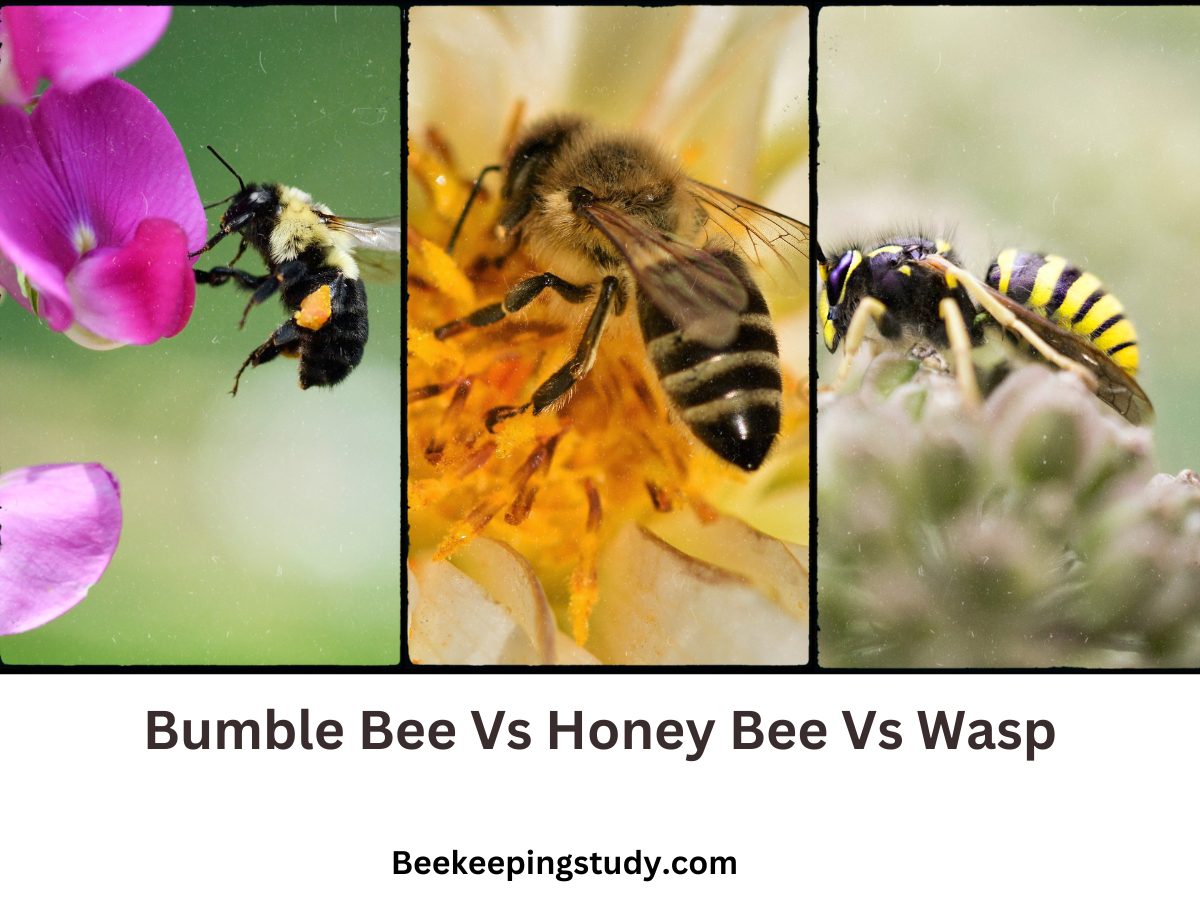
People often get confused about whether it is a honey bee, or bumble bee, or wasp. But you can easily differentiate them by closely looking at them.
Honey Bee: Honey bees have yellow or light brown bodies with dark brown stripes. They are comparatively smaller than both bumble bees and wasps. They are 8 to 15 mm long, depending on their species. They have less hair density on their body than bumble bees. They have more fat bodies than bumble bees and wasps.

BumbleBee: Bumble bees have different colors, like black, yellow, brown, orange, etc. They have more dense hairy bodies than honey bees. They are also larger than honey bees (10 to 20 mm). They have thinner bodies than honey bees.

Wasp: Wasp have a larger body than both honey bees and bumble bees. Wasp’s main difference from honey bees and bumble bees is that it has a clear abdomen.

It has less hair on its body. Its wings are also far from each other. Wasp can be black, brown, yellow, or any combination of these colors.
Life Style
Both honey bees and bumble bees live in a colony. Some of the wasps are colonial (e.g. yellow jackets, hornets) but most others are solitary.
In honey bee, bumble bee, and wasp colony there are 3 types of members.
- Queen.
- Workers.
- Drones.
The queen lays fertilized eggs for reproduction. Drones are only for mating purposes. All the workers provide shelter and take care of the broods.
Wasps that are solitary don’t have a large colony. They live individually.
A honey bee colony can live in the same location for the entire year. But bumble bees do not live in the same location for the entire year. The hibernation or migration behaviour of honey bees and bumble bees is different.
Bumble bee starts creating nests during early fall and emerge to a new location when winter arrives. But honey bees stays inside the hive to protect the colony from cold during winter.
A wasp has a similar lifestyle to a bumblebee. Most of the wasps are season-oriented. They do not live in the same location for long.
For honey bees, the workers sent scout bees to select nest sites. Then the queen emerges to that location to create their nest. The workers do all the nest construction work from wax.
Whereas in the case of bumble bees and wasps, the mated queen built a nest on her own to lay eggs. From those eggs, a colony is produced during spring. After the season ends, she emerges in a new location. In that location, the workers built the nest and took care of the queen and broods.
Is There A King Bee?
Nesting
Honey bees live above the ground. They select suitable nest sites close to flowering plants, far from the ground. They build their nest from wax in the holo space in a tree, in a small cave, in an old house wall, or in a similar type of location.
Honey bees also live in a man-made nest that is in a beehive that beekeepers use to keep bees. Whereas Bumble bees create their nest close to the ground and underground. They like to create their nest in rocks, hollow cavities, below piles of leaves, grass, etc.
Most of the social wasps create paper-like nests. They are often found in a small nest attached to tree branches, eaves, house walls, etc. The solitary wasps usually create their nest in an underground cavity or in the leaves.
Honey bee has a larger colony, so their nest is also larger than bumblebee and wasp nest. In a honey bee colony, there are a few thousand to more than 60,000 members, depending on its size.
Whereas a bumble bee colony contains only a few hundred. The wasp colony can be smaller or sometimes even larger than the honey bee colony.
Food Habitant
All of these 3 insects eat pollen and nectar. But wasp do not solely depends on nectar and pollen. They prey on insects like ants and butterflies.
Honey bee’s primary food source is flowers. They collect pollen and nectar from flowers to feed their broods and to produce surplus honey.
Whereas bumble bees only collect pollen and nectar to feed their younger members. They do not store honey. Wasps are also similar.
Wasps can prey on insects, whereas bees, like bumble bees and honey bees, do not seem to prey on insects. They can eat different things, like fallen fruits, tree sap, etc, when there are no flowers.
Reproduction
As honey bees, bumble bees, and a few species of wasps are social insects, they have only one reproductive member, and that is their queen. Female workers may also lay eggs, but those are not fertilized eggs.
Only the queen can lay fertilized eggs on which the growth of the colony depends. No other female of the colony is reproducible.
For solitary wasp species, almost all of the females are capable of reproduction. As they live individually, they lay eggs to build their own family. Usually, solitary wasps live within the same family as a female wasp with her broods or sisters together.
Communication
Honey bees are famous for their “waggle dance” and “round dance” used for communication. Through waggle dance, honey bees transfer information about the food source to other members of the colony. The quality of nectar, distance of food source, angle of direction, and other information are shared by different waggle dances.
The round dance is used to inform about the danger, nesting site location, the suitability of the discovered nest site, etc.
They also stick together during danger by releasing pheromones. When any of the colony members identify dangers, they notify the other members through different dances or by releasing pheromones.
In the case of bumble bees and wasps, they release pheromones to communicate with each other. Bumble bees can share information by swinging around or by releasing pheromones. Wasps only communicate with each other about food sources and nesting sites through pheromones.
Stinger
The honey bee has a one-time usable barbed, tiny backward-facing sting. When they sting someone, they release both their sting and venom into the victim’s body. Thus, the stinging bee dies immediately after stinging someone.

Bumble bees have a similar barbed sting, but they can repeatedly use their sting. It doesn’t leave its sting on the human body.
Wasp has a smoother stinger. They can sting and release venom into the victim’s body as many times as they want. They do not leave their sting on the victim’s body.
Whose Sting Is More Poisonous Bumble Bee vs Honey Bee vs Wasp
Among honey bees, bumble bees, and wasps, the wasp has the most poisonous sting. They have smooth stings which they do not leave in the human body. They can sting repeatedly without any problem and inject venom into the victim’s body.
But different people may have different effects on the stingers of different insects. Different people have different allergic reactions to the sting of a bee or wasp. Usually, bee stings are considered less poisonous than some species of wasps.
Aggressiveness
Wasps are comparatively more aggressive than honey bees and bumble bees. Honey bees are less aggressive than wasps. Honey bees have barbed stings, which they can use only once in their lifetime.
After stinging someone, a honey bee will die immediately as the sting is detached from its body after stinging. But when the colony is in danger, honey bees won’t hesitate to attack the danger even if it costs their life.
Bumble bees are less aggressive than both honey bees and wasps. They can sting more than once. So, their sting is not too painful. Because the bumblebee doesn’t inject its sting into the human body. It preserves the sting for future use.
Both bumble bees and honey bees won’t sting someone unless they are disturbed. Some wasp species are very aggressive and may sting you without any concern.
Why Wasps Are So Aggressive?

Honey Production
Only honey bees produce surplus honey, which they store for the winter. Beekeepers extract a portion of the surplus honey for human consumption. But bumble bees and wasps do not produce surplus honey.
Bumble bees produce a small amount of honey to feed their broods. But wasps do not produce honey at all. They fed their younger ones nectar collected from flowers or small insects.
In fact, some wasps try to steal honey from a honey bee colony. They will fail and be beaten by the honey bees if the honey bee colony is strong. But a weak honey bee colony can become a victim of a giant hornet attack.
Comparison Of Bumblebee vs Honey Bee vs Wasp
A comparison of bumble bee vs honey bee vs wasp is given in the table below.
| Characteristics | Bumblebee | Honey Bee | Wasp |
| Size | Larger than honey bees usually 10 to 25 mm long. | Smaller than wasps and bumble bees (Up to 15 mm long). | Usually 8 to 25 mm long. |
| Nature | Social | Social | Both social and solitary. |
| Body Hair | Dense hairy body. | Less dense hairy body. | Very little hair on their body. |
| Body Color | Black, yellow, orange, etc. | Golden or yellow with dark brown stripes on their body. | Black, yellow, brown, etc. |
| Stinger | Burb stinger and can sting multiple times. | Burb stinger and one-time use only. | Smooth stinger and reusable any number of times. |
| Aggressiveness | Less aggressive | Moderate aggressive | Very aggressive |
| Nest | Close to the ground | Far from ground | Paper-like nest in any suitable location |
| Diet | Pollen and nectar from flowers, fruit juice, sugary foods, etc. | Solely depends on pollen and nectar | Pollen and nectar, fruits, insects, etc. |
| Honey Production | Very small amount for feeding broods. | Surplus production of honey. | Don’t produce honey. |
| Colony Size | A few to one hundred bees. | Can be as large as over 50,000 per colony. | Can be from a few to up to 10,000 per colony. |
| Life Span | The queen can live up to one year. | The queen can live up to 4 years. | Wasp queen can live up to a year. |

Which Insect Is Best For Beekeeping?
Among bumble bees vs honey bee vs wasps, honey bees are popular for beekeeping. But some beekeepers also keep bumble bees. However, beekeepers do not like to keep wasps, as wasps are very aggressive.

Honey bees are more famous because of their surplus production of honey. Moreover, bumble bees don’t stay more than a season in the same location. This is why beekeepers prefer the honey bee more than any other bees for beekeeping.
Tips To Avoid Getting Stung By Bees And Wasps
Bees and wasps are both stinging insects. So, whenever they felt threatened, they wouldn’t hesitate to sting. The best way to avoid getting stung by such insects is to avoid interaction with them.

Have you noticed beekeepers handling bees without getting stung? How do beekeepers not get stung?
Because they know how to deal with bees. For normal people, it is not preferred to interact with bees or wasps. Wasps are very dangerous. So avoid any type of interaction with them.
Here are some tips to avoid getting stung by stinging insects.
- Try to avoid disturbing them.
- Don’t run when they see you. Because wasps or bee swarms can be dangerous. They can attack you if you suddenly start running when passing their nest.
- If you are a beekeeper, try to wear protective gear during a hive inspection.
- Make sure to select the right time for hive inspection. It is to make sure bees are in good mood to welcome you for inspection.
- For beehive removal, call an expert beekeeper or pest control specialist. Don’t approach a beehive without any prior knowledge.
What To Do If You Get Stung By A Bee or Wasp?
You may get stung by bees or wasps without disturbing them. It is common. Don’t get panicked. In most cases, bee or wasp stings are not too poisonous.

It may hurt for a while. Within a few minutes, the pain will start to reduce. Usually, the venom from a bee or wasp sting doesn’t harm humans much.
In case, you have an allergic syndrome to bee or wasp sting, it could be harmful for you. In such conditions, contact a medical specialist without wasting any time.
Frequently Asked Questions
No, a honey bee sting is considered less poisonous than a wasp sting. Honey bees can only sting once, whereas wasps can sting repeatedly. This is why a wasp sting is worse than a honey bee sting. Usually, wasp stings their prey, and humans, don't bite. If they feel threatened to you it will sting you within a second. A wasp sting can cause a mild to serious toxic effect on humans. Depending on your physical condition and the type of wasp, its sting can cause normal skin irritation to a direct organ injury too. It depends on how your body reacts to the wasp sting. No dead stinging insect can intentionally sting anybody. But if you try to squeeze the wasp with your hand or any body parts, the sting of the dead wasp may be injected into your body. Thus you can get stung by its sting.Is a honey bee sting worse than a wasp sting?
Can a wasp bite you?
How toxic is a wasp sting?
Can a dead wasp sting you?
References
- Honey Bee – Wikipedia.
- Bumblebee – Wikipedia.
- Wasp – Wikipedia.
Mass envenomations by honey bees and wasps. Authors: R S Vetter, P K Visscher, and S Camazine.
- Why we love bees and hate wasps. Authors: Seirian Sumner, Georgia Law, Alessandro Cini