This post might be created with help from AI tools and carefully reviewed by a human (Anthor Kumar Das). For more on how we use AI on this site, check out our Editorial Policy. This post contains affiliate links. We may earn a small commission at no extra cost to you. Learn more.
Phobia of Bees [How to Overcome]
Do you have an intense, overwhelming fear of bees? This means you have a phobia of bees. A phobia of bees means intense fear of bees when someone sees or even just imagines bees.
Let’s dig deep into this topic. Also, some tips to overcome the fear of bees. If you have extreme symptoms, possible medical treatments are also discussed.
What is a Phobia of Bees
A phobia of bees is technically called melissophobia, an intense fear of bees when someone sees or imagines bees.
Some people also call it apiphobia or apiophobia. The “api-“ prefix comes from apis, the Latin word for bee. The “melisso-“ prefix comes from the Greek word for honeybee.
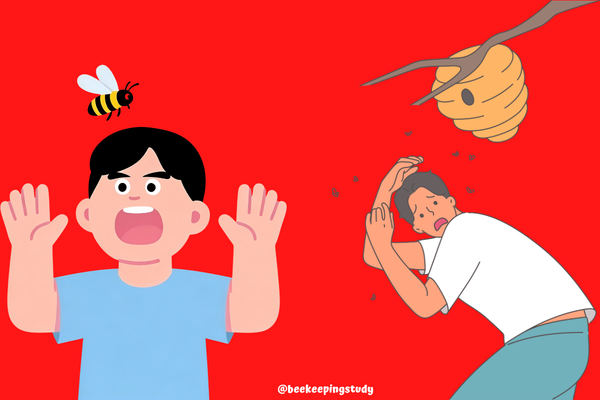
Here’s the key part. It’s a fear that’s way out of proportion to the actual danger. It’s classified as a specific phobia under the DSM-5, and it produces fear disproportionate to any real threat bees pose. That’s the line between a phobia and just normal caution.
There’s one important exception. If someone has a life-threatening allergy to stings, their fear is considered rational rather than a phobia. That’s a real risk, not an irrational one.
How Common is it?
It’s very common in most parts of the world. Research found that around 6% of people in the United States has insect related phobia.
Specific phobias affect women at roughly twice the rate of men. Many cases start in childhood or early adulthood.
I found a common, surprising thing repeatedly while reading through forums.
You don’t have to be stung by bees to develop a phobia of bees.
On one forum, a user wrote that he’d been scared of bees since childhood. He said he never had a scary confrontation with bees. But he still couldn’t stop himself from flipping out when one flew close.
He described getting a violent chill through his body. Others in the same thread supported it. Several admitted they’d never been stung, but they still have a phobia of bees.
Of course, some cases do trace back to a bad sting. My cousin got attacked by a swarm of wasps. The effect was disastrous for him.
Almost his whole body was covered by wasps and stung him through. We had to take him to the hospital for treatment.

He developed a serious allergy afterward. As a result, he is still in shock when he sees any bees or wasps. He has a serious fear of a swarm of bees.
However, a swarm of bees is not as dangerous as a swarm of wasps.
Symptoms & Key Points Regarding Phobia of Bees
Here are some key points and symptoms of someone having a phobia of bees.
- A phobia of bees starts in childhood and grows through adulthood.
- Intense fear builds up when you see bees waggling around or just imagine any kind of bees.
- You often know the fear is unreasonable, but you can’t control it.
- You go out of your way to avoid places where bees might be.
- Panic attacks and urges to run away are common responses when spotting any bee nearby.
- It can form through observational learning or repeated warnings. Such as hearing a “killer bee” story or about someone getting attacked by a bee swarm.
Everyone possesses fear differently. Consult with a health care specialist if you have extreme fear of bees.
How to Overcome Bee Phobia
Got an extreme fear of bees? Don’t worry! This one is treatable in most cases. Here is what works to overcome fear of bees.
1) Don’t Lean on Avoidance
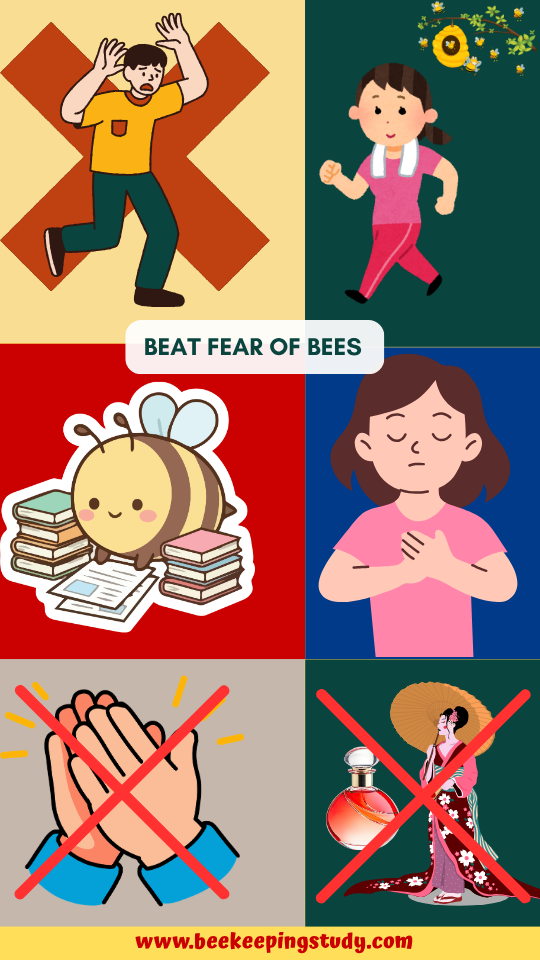
It’s a trap, not a fix. Avoiding bees feels safe for a moment but is not a permanent solution. It can make the phobia of bees worse over time. So, next time, stay calm and don’t avoid the place if you see bees nearby.
2) Take Small Exposure Steps
This is the heart of building a habit to overcome the fear of bees. Instead of avoiding, try to slowly walk through a park or place where bees can be. Maintain a safe distance but don’t run away.
It would be best if you could meet a beekeeper working with bees. Meeting a beekeeper during hive inspection will work faster than anything else.
So, start tiny from today and build up slowly!
3) Learn More About Bees
Learning about bees will help you to know about their importance to us. You can read bees and beekeeping related books.
Join your local library and spend some time reading books related to bees. This will help you to learn their importance and their instinct.
Also, learn the difference between bees and wasps. Because wasps are aggressive, while bees are not.
4) Stay Calm Around Bees
Bees will sting you if you try to move fast or run away while passing them. They won’t sting you if you stay calm around them.
Bees only sting someone if they find them a threat. They decide a threat by observing a few signs. Moving fast when passing by is a sign of a threat.
Try to walk slowly when passing by a beehive. If you start running suddenly, you might end up getting by stung.
5) Don’t Swat Ever Around Bees
Swatting is a dangerous mistake people often make when they see any bee. If you see a bee is bothering you, simply walk away, but don’t swat or start running.
6) Avoid a Few Things Around a Beehive
Bees don’t like some smells and colors. So, try to avoid any strong-smelling perfume and colorful dress if you are living in a bee-heavy area. This is why you might see beekeepers often wear a white colored suit when inspecting a beehive.
7) Help Bees in Many Ways
If you help bees, bees will be helpful for you as well. Because bees can remember face who helped them repeatedly. This is why sometimes you might see a beekeeper interacting with bees without any protective gear.
There are several ways to help bees. The best way is to plant bee-friendly plants in your yard. This will not just help bees, will be helpful for your garden as well. You will see enhanced productions in fruits and blossoms.
Treatments Available to Overcome Extreme Fear of Bees
If the fear is severe, disrupting your life, or triggering panic attacks, professional help works remarkably well. Remember, before deciding on any medical treatment, consult with your doctor and seek medical help.
Here are the available treatments that are common in curing severe fear of bees.
Exposure Therapy is the Gold Standard
This is the single most effective treatment for curing a phobia of bees. You’re gradually exposed to the feared thing, repeatedly, until it no longer provokes a fear reaction.
Research shows exposure therapy successfully treats up to 80–90% of patients who complete it. And it lasts. In one follow-up after an average of 4 years, 90% of patients still had a significant reduction in fear and avoidance, and 65% no longer had the phobia at all.
One-Session Treatment (OST) – A Real Game Changer
You won’t need a month of treatments to reduce fear of bees. OST combines exposure, modelling, cognitive challenges, and reinforcement into a single session of up to three hours.
One-Session Treatment had similar clinical effectiveness to multi-session CBT for specific phobias, and may be a cheaper alternative. Research found that OST works best in animal phobias such as a phobia of bees.
Cognitive Behavioural Therapy (CBT)
This is a broader framework which combined with exposure. In CBT, the reason behind the inaccurate threat belief is identified. Based on the type of thought and belief, therapy is provided to overcome that.
Virtual Reality Exposure Therapy (VRET)
This is a modern technology that uses virtual reality to interact with bees. This is used when real bees are hard to arrange safely.
Interacting with bees in virtual reality helps the patient to gradually reduce the fear of bees. With time, the patient is able to interact with bees in the real world as well.
One study founds VR based and real image exposure successfully decreased anxiety and phobia scores. Have to be followed up for a few months for the highest result.